Search This Blog

Showing posts with label Postcolonial. Show all posts

Friday, 18 September 2020

Homegoing (2016)

I found Yaa Gyansi's novel Homegoing on my to-read list when I was choosing a title for a bookclub with my teenage niece and her mother at the beginning of lockdown. It made it on my list via bookstagram (though I can't quite recall who exactly made the recommendation). The novel was published by Penguin in 2016 and is 220 pages long (Kindle edition noted 315 pages). It consists of two parts with 14 chapters. The story spans a period of three hundred years, following the descendants of two Ghanaian sisters. I will explore the format and style of the book as well as discuss some of the key themes alongside my personal reflections. 


The novel begins with an Akan proverb that notes the importance of every member of the family. Gyansi then provides a family tree for the reader to refer back to. The structure of the novel follows a generational format, where each chapter follows a character of the next generation of one of the family lines. As such, the chapters are named after the focalised character. Homegoing is written with a third person narrator who focalises into the central character of the chapter, and through their interactions the reader engages with auxiliary characters. I found that this generational approach to the chapters was really effective and powerful in exploring how social conditions changed (if at all). It also permitted the author to navigate and demonstrate the effects of intergenerational traumas as well as lost lineage and identity. Since each character represents a familial generation as well as a socio-political environment, their chapter can almost be read as a short story, albeit interwoven with the preceding and succeeding narratives. 

Homegoing begins in Ghana at the beginning of colonisation and is implicated in the slave trade. The social dynamics are complex and hierarchies are being continuously challenged. This environment brings to the fore the dehumanising and racist discourse at the heart of these injustices. As one family line remains in Ghana and the other is sent to toil in America, Gyansi demonstrates how whiteness, whether in the context of slavery or colonisation and missionary efforts, shaped the characters' experiences on the two continents. That being said, she also highlights how colonisation and slavery have morphed to take on other forms in the present (i.e. modern day prison systems). It provokes debate as to how deeply rooted the problem really is to this day. 

Women and womanhood are a huge theme in the novel, and they explored from so many angles that my short paragraph definitely will not do it justice (perhaps someone can write an essay or thesis on the matter instead). However, I do still want to note some significant points. The matrilineal line of descendants is a distinct reminder of the status of women and the power of womanhood in society, especially given that they are also subject to violence, and risk being treated as assets, thus making them vulnerable. These oppositions consequently demonstrate the complexity of womanhood as we witness empowered femininity and subjugated femininity. In addition to this, we see how the trauma women experience is passed down through generations, compounding the struggles each generation inherits. 

I was pleased to read Gyansi's representation of (historic) tribal Africa, where polygamous households are a norm and not looked upon condescendingly. As with all family structures, there are complexities but it was refreshing to visualise a co-operative society with joint families where there is mutual respect between men and women, each bringing to the table their own contributions for the prosperity of the whole family. No doubt it is also a competitive society where tribes and tribesmen compete for strength, reputation and power, yet there is a notion of responsibility towards others that is enshrined in this, combatting excess selfishness.

Naturally, sex is a prerequisite to form generations in a family line and therefore sexual encounters are fairly frequent in the novel. I mention this in case you are selecting this for younger readers, as I was unaware of this when choosing to read this with my 13-year old niece. Her mother also read the book and decided she would rather her daughter read the book at a later age, as sexual violence is also explored. Otherwise, I found that these scenes were always relevant and carefully written, unlike some texts that are rather gratuitous and vulgar in this regard. Gyansi represents the nuances of sexual relations, as they demonstrate power dynamics between couples as well as sources of pleasure, or how they play an important spiritual and cultural role. I also considered Gyansi's writing to be sensitive to "forbidden" love and notions of homosexual desire.  

Overall, Homegoing is an excellent novel that everyone ought to read for both the content and the writing style (age permitting). It deals with deep emotions and a realm of complex situations and scenarios that underline the complexity of history and the present of Black lives. Of course it is also heartbreaking to read this knowing that it is "merely" fiction, thus the reality of injustice must be significantly worse, however unpalatable that may seem. This is a valuable book because of the story it tells and it is also well-written and engaging in its form and style. The stories are a powerful reminder of just a fraction of the dark history of domination this world has seen. 

***

Have you read this novel? What did you think of it? Comment your thoughts below, I'd love to hear what you thought. 

*** 

Follow me on instagram @nafisasiddique for updates on my latest posts. 


Sunday, 28 June 2020

The Sultan's Daughter (2020)

An ARC of this fantasy novella, written by P.E. Gilbert was gifted to me in exchange for an honest review. The Sultan's Daughter is a quick read of 11 chapters and around 50 pages. It will be self-published by the author in July 2020 in print edition and kindle edition. I will offer a brief, spoiler-free outline of the novella before addressing a few key themes and my thoughts on how they were addressed. 


The story is a set in a pre-modern, oriental fantasy world, which has its own "Charted Map" found at the beginning of the book. This region forms a kingdom and experiences conflict due to power struggles linked to bloodline but more significantly relating to religious beliefs. The initial scene introduces the dying Sultan in his deathbed bestowing heavy responsibilities onto his daughter's shoulders. The rest of the plot relates to how she executes these last wishes. Gilbert provides several discussion questions at the end of the book to provoke further reflection on some of the plot's themes and events. 

The central theme of the novella is the fight between good and bad, which in this case is between the religiously devout and the religious fanatics of the imaginary faith that believes in Abyars as a deity. It is striking that the "hardline" Aybars' laws include lashing for fornication and cutting off hands for stealing and one of their erroneous desires is to want to wage a holy war to regain access to the holy city of Zenith. These parallels to things attributed to some Muslims and/ or governments or groups is hard to ignore. Ultimately we find two Eastern sects fighting each other for faith-based reasons, and these oppositions are not particularly nuanced or subtle. Interestingly the good side, show little evidence of actual devotion. There is much political commentary to be made in this respect, but I will not delve into this in this post. 

As the title suggests, this novella is about a young woman, namely Nalini, who is the Sultan's daughter. Nalini's character evolves significantly through the rapid turns of events.  She begins as a rather submissive and overly-obedient daughter. She later develops into a determined and, arguably, stubborn, albeit insecure, character. Personally, I did not find her character to be amiable. While I admit that not all protagonists need to be beautiful, I found it noteworthy that Nalini is described as one with "little beauty" and has a "darker complexion" than her husband Emilio, the fair-skinned heathen, who happens to be a more sympathetic character than Nalini herself. These characterisations are problematic especially when considering a post-colonial reading of texts. 

Moreover, with a largely male character cast and central female protagonist, there appears to be an attempt to assert feminine empowerment. This power is bestowed upon a woman by men, and Nalini is hesitant to accept it but does so mainly because it is not prohibited in the religious laws. While she is hard-working and demonstrates immense self-restraint, sometimes it is to unhealthy degrees and makes me question her actual competence. She seems to go from being an extremely passive feminine stereotype to someone trying to avoid association to femininity through any expression of weakness. In my opinion she is yet to reach her full potential by the end of the story. This transition of feminine expression requires more depth and nuance. 

The writing style of the novel is fluid. Gilbert makes use of a third-person narrator who focalises into Nalini's experience of events. In this respect, the novella's perspective is highly influenced by her subjectivities, including her inner turmoil and outer appearances. Due to this dual access, it is easier to criticise her more precisely than the other characters. I found Gilbert's discussion questions to be a a nice way to engage more thoughtfully in a short read. 

Overall, the novella was a quick read, with an eventful plot. In some ways it seems like it is not just an oriental fantasy but also an orientalist fantasy. Gilbert deals with major, complex issues and the length of the work may have been a restriction in fully exploring them with due justice. I would like to thank the author P.E. Gilbert for the opportunity to honestly review his hard work.

***

Is this a novella genre that interests you? What do you normally like to read? Comment your thoughts below, I'd love to hear about your reading preferences. 

*** 

Follow me on instagram @nafisasiddique for updates on my latest posts. 

Thursday, 28 May 2020

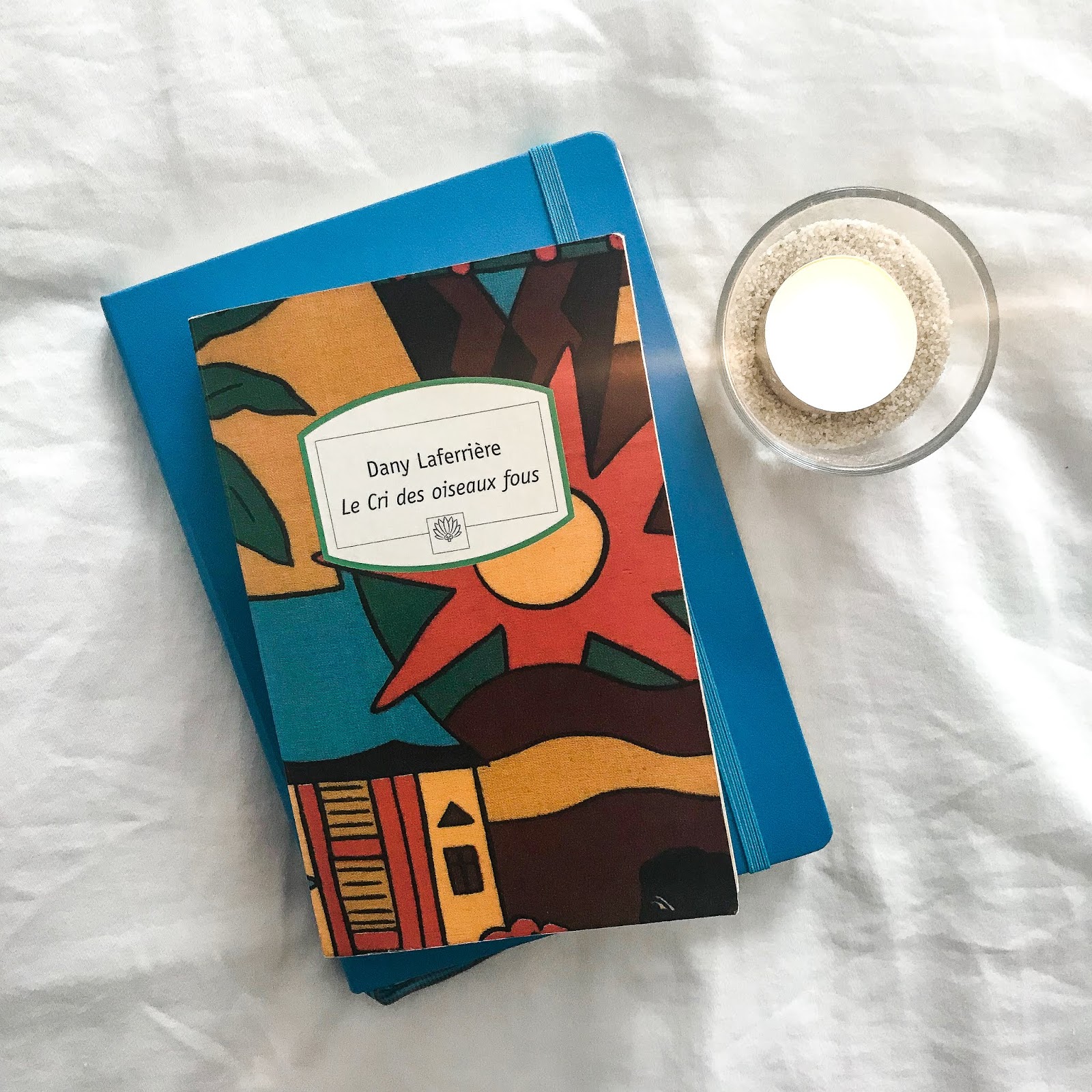
Le Cri des Oiseaux Fous (2000)

This autobiographical novel was first introduced to me in my final year of my Bachelors (2014) in one of my French modules; it was one of the primary texts and one of the first full-length novels in French I was to read. I really enjoyed reading it at the time, and even revising the text during exam season! So I decided to re-read the novel to begin reading more in French again and to see how my relationship with the text has developed. I am writing this review in English for fellow French-reading anglophones, though there is a French version too. 


My edition was published by Le Serpent à Plumes in 2002, though it was originally published by Lanctot Éditeur in 2000. Dany Laferrière's 346-paged novel is divided into short time-stamped chapters during the course of 24 hours, which are the last 24 hours the author experiences in his homeland Haiti before being exiled indefinitely. It is written with a first-person narrative, following the protagonist's thoughts where he offers a very personal perception of people, things and events. I will explore some of the key themes and reflections in the book alongside my own reading experience. 

Vieux Os (Old Bones), La Ferrière's pseudonym, is driven to exile following the unprecedented assassination of his close friend Gasner. This assassination sets the scene of 1976 politics in Haiti, a country living under the harsh dictatorship of Baby Doc (Jean-Claude Duvalier) which is in itself a legacy of Papa Doc (Francois Duvalier). Therefore this a highly political novel, as we learn much about the culture and lifestyle this dictatorship creates. Vieux Os compares the two dictatorships with the latter seemingly even more corrupt than the former, yet both with their own approach to brutality and control. Such torture and suffering is no doubt feared yet there are notions of whether it is better to be tortured by your own (Haitian government) or by others, referring to suffering at the hands of white people in foreign countries or even during the period of enslavement. Does it matter who is subjecting you to mistreatment?

Gasner's assassination raises many reflections on the nature of friendship and various types of friendships that Vieux Os holds close to his heart. We learn the secret "codes" they hold between themselves as well as the rarity of good, safe friendships in a world ridden with spies, traitors and "tonton macoutes", the dictatorship's police force. Since friendship is the catalyst for exile in many ways, it cannot go without analysis in our very contemplative protagonist's mind. 

As we learn about Haiti's culture through our protagonist, we are soon exposed to its unique religious environment where two dominant religions reside: Catholicism and Vaudou (or Vodou). This religious dichotomy not only represents ancient practises versus colonial teachings, it also shows different approaches to faith and seeking strength and hope in the tense environment. Laferrière does not shy away from intertwining Vaudou gods or beliefs in his writing, even in subtle ways when recalling his deceased friend thus engaging the reader with the religion.

Women play an important role in Haiti and in Vieux Os' last day in the country. We are introduced to many different types of women, from the saintly, grief-stricken mothers to vulgar temptresses and many somewhere on the spectrum between those extremes. Thus Laferrière explores lust and temptation as well as love and commitment. We learn how women are integral to keeping homes and the country running, as men are so often being persecuted. Laferrière shines a light on the strength of womanhood in such extreme conditions. 

The novel also delves into the world of prostitution, a strategic industry nurtured by the dictatorship to contribute to weakening the population. Moreover, prostitutes have access to a world of deep, dark secrets and are thus valuable sources. In some ways we see the human side of such a vulnerable and potentially brutal career.

Overall, I found it a pleasure to read this autobiographical novel. Laferrière explores a vast range of themes connected to his life and nation from family and friendship to life and death. Because this novel is based on the author's real life experiences and many of the characters are presumed to be real to some capacity or another, I was left with the desire to know more about what happened to the author himself and his parents- which would mean I need to look for the corresponding books in his long series. I enjoyed the writing style as I found it amusing in places, which balanced out some of the sorrow

***

Have you read this novel? What did you think of it? Comment your thoughts below, I'd love to hear what you thought. 

*** 

Follow me on instagram @nafisasiddique for updates on my latest posts.

Le Cri des Oiseaux Fous (2000) - français

Ce roman autobiographique écrit par Dany Laferrière m'a été présenté pour la première fois pendant ma licence de français. Il m'avait beaucoup plu à l'époque et je voulais le lire à nouveau afin de voir si mes impressions ont changé depuis. Mon édition est celle du “Serpent à Plumes” de 2002, mais le roman a été publiée une première fois par Lanctot Éditeur en 2000. Cette oeuvre de 346 pages est divisée en petits chapitres horodatés, en poursuivant les dernières 24 heures à Haiti avant l'exil indéfini de l'auteur. Il est écrit à la première personne et suit les pensées profondes du protagoniste qui propose des réflexions très personnelles à propos des choses, des gens et des événements. J'examinerai plusieurs thèmes importants et donnerai ma réaction personnelle dans ce compte-rendu. 


Vieux Os, le pseudonyme de l'auteur dans le roman, est obligé de partir de son pays en exil après l'assassinat de son ami proche, Gasner. Les assassinats et l'exil sont des circonstances bien connues dans le contexte politique de Haiti sous la dictature de Baby Doc (Jean-Claude Duvalier), héritier du pays après le décès de son père Papa Doc (Francois Duvalier). Il s'agit donc de la politique de la dictature et ses conséquences dans la culture nationale. Vieux Os compare les deux dictatures où la première semblait être moins corrompue que la seconde, mais où chacune a eu sa manière de surveillance et de brutalité sur le peuple. Une réflexion approfondie amène la question importante suivante : vaut-il mieux être torturé par les siens (son propre gouvernement ou ses congénères) ou par des étrangers (rappelant l'oppression de l'esclavage, la colonisation et même la domination raciale)? Comment cela importe-t-il? 

En perdant soudainement un ami proche, Vieux Os se retrouve à analyser ses amitiés variées qu'il tient à coeur. Nous apprenons ses "codes" privés entre amis et aussi comment les bonnes amitiés, sans danger, sont si rares dans un monde rempli d'espions, de traîtres et de tontons macoutes, la police de la dictature. Les réflexions à propos de l'amitié de notre protagoniste contemplatif ne peuvent être ignorées car l'amitié est le catalyseur même de son exil.

La culture de Haiti révèle un environnement religieux unique qui consiste de deux religions principales: le Catholicisme et le Vaudou. Ces deux religions représentent à la fois les anciennes pratiques et les enseignements coloniaux; nous voyons aussi des approches différentes pour trouver l'espoir et la force dans les conditions difficiles. Laferrière entrelace son histoire avec les dieux et les croyances Vaudou de manière subtile et évidente. 

Les femmes jouent un rôle important dans le pays et durant les dernières 24 heures de Vieux Os dans le pays. Il nous présente des femmes de toutes sortes, des mamans angéliques accablées de douleur aux séductrices impétueuses, et toute une variété entre ces deux extrêmes. Ainsi, Laferrière nous présente une exploration du désir et de la tentation ainsi que l'amour pur et l'engagement. Les femmes semblent faire fonctionner le pays et leurs maisons pendant que les hommes font face à la persécution politique, ce qui souligne la force de la féminité dans des conditions extrêmes.

Le roman plonge aussi dans le monde de la prostitution, un secteur stratégique de la part de la dictature pour affaiblir la population. De plus, les prostituées sont des sources d’informations précieuses grâce à leur accès à un monde rempli des secrets les plus profonds. Nous découvrons aussi un côté humain à une profession tellement vulnérable et potentiellement brutale. 

Dans l'ensemble, le roman était encore une fois un plaisir à lire et j'ai pu l'apprécier différemment cette fois-ci comme mon français s’est amélioré. Laferrière étudie un grand nombre de thèmes liés à sa vie et son pays, de la famille et l'amitié à la vie et la mort. La présence de passages amusants compense la tristesse poignante. Parce que ce roman est inspiré de la vie réelle de l'auteur, je me suis retrouvée extrêmement curieuse de la suite des événements surtout par rapport à ses relations avec ses parents. Cette curiosité me poussera à chercher les romans correspondants que Laferrière a écrit.   

***

Est-ce que vous avez lu ce roman? Comment vous l’avez trouvez? J’aimerais bien lire vos pensées ci-dessous! 


Tuesday, 3 December 2019

Rich People Problems (2017)

Rich People Problems is the final novel in the trilogy by Kevin Kwan, published in 2017 by Doubleday (Penguin). My digital edition was 393 pages (paperback 384 pages) and the novel was divided into four parts with a total of 56 chapters with added prologue and epilogue. I will share my thoughts on the content, form and generally compare it to the two preceding novels. 


Kwan chooses to play with his writing in this novel by keeping some elements the same (chapters headed by locations) but also offering the readers more "first-hand" information from sources like magazine articles, adverts and other literary sources. This, as well as the different focuses Kwan offers in each chapter, provide a range of perspectives for the reader in an intertwined plot. Kwan pulls this off really well and it keeps the novel dynamic and engaging. He competently adapts his writing styles to the literary sources, from diary entries to gossip articles and they help to make the reader feel more involved with the whole intrigue. A few new settings (especially in India) added a new flavour to the range of experiences he described too, and I definitely appreciated those brief "visits". 

As far as the storyline goes, Rich People Problems gave me what I wanted (to develop the story between Nick and his grandmother- and Tyersall Park) and much more. Kwan manages to combine and tie up both the first and second novels extremely well. It justifies and compensates the second novel, for China Rich Girlfriend does provide a fair amount of background for half of this novel's story. I found this final story to be extremely eventful, which offered a good pace to all the happenings. Kwan managed to keep the balance between creating suspense and filling scenarios with emotion without them lingering on for too long and allowing the reader some relief or at least some progress on the issue(s) at hand. 

I also valued Kwan's approach to history in this novel. Crazy Rich Asians and Rich People Problems offer a colonial context to Singapore, especially in its architecture, but I liked how Kwan went the extra mile in this novel. By taking the reader into the past, Kwan characterised Su Yi more thoroughly as well as deepen our understanding of the relationships in the novel. 

Overall, I have to say I loved this book as much as the first one and it gave me much more than what I was expecting. I'm glad I chose to read the final of the trilogy despite the slight "slump" in the middle. Believe it or not, this novel shows that rich people do have a whole host of problems. Ranging from being accepted into high society to inheritance and being released of the "shackles" of elite norms, Rich People Problems definitely offers readers an enjoyable and emotional experience into this wealthy world.

***

Have you read this novel? What did you think of it? Comment your thoughts below, I'd love to hear what you thought. 

*** 

Follow me on instagram @nafisasiddique for updates on my latest posts. 

Monday, 25 November 2019

The Watermelon Boys: A Novel (2018)

When I found out that my brother’s best friend’s sister had published a book, I had to get my hands on it, albeit a year late. Since, this novel has received the Betty Trask Award. The Watermelon Boys by Ruqaya Izzidien is a 349-page novel (or 352 with the Author’s Note) published in 2018 by Hoopoe, Cairo. It comprises of 57 chapters divided into three parts. I’ll firstly note the details of her award and include the book’s description (or blurb) before going into my review. Note, I read this novel in April 2019 and just gotten round to publishing my thoughts now.

Izzidien’s novel is one of the six winners of the 2019 Betty Trask Awards, bestowed annually by the prestigious Society of Authors’ Awards in recognition of the best and most promising first novels written by authors under the age of 35 in a traditional or romantic, but not experimental, style. (Source below)


Book description:
It is the winter of 1915 and Iraq has been engulfed by the First World War. Hungry for independence from Ottoman rule, Ahmad leaves his peaceful family life on the banks of the Tigris to join the British-led revolt. Thousands of miles away, Welsh teenager Carwyn reluctantly enlists and is sent, via Gallipoli and Egypt, to the Mesopotamia campaign. Carwyn’s and Ahmad’s paths cross, and their fates are bound together. Both are forever changed, not only by their experience of war, but also by the parallel discrimination and betrayal they face.


The narrator powerfully begins the novel in the first-person plural (we), implicating each of us into history before switching to a third-person voice, focalising into Ahmad’s experience, but then later also that of Carwyn, To a lesser degree the narrator focalises into other characters’ experiences too. Izzidien chooses an effective writing style for the story she has crafted. She skilfully recounts several tender scenes and also succeeds in creating tension and expressing passion, thus taking the reader through an emotional journey as well as a historical one. The narrator offers deep words of truth and contemplation on several occasions in the novel, which call out the ongoing state of the world and contemporary human relations. Bringing in these reflections and connecting history to the present day serves to spark reflection in terms of what we can learn from history and how much of it we allow to be repeated. It also prevents us from disassociating ourselves from people of the past as mere characters. 


While this novel focuses largely on Ahmed and his sons in the light of historic events, as they are the titled watermelon boys who sell the fruits along the Tigris, we also meet strong female characters. They are gracious and admirable without being clichés or cringingly naive. Izzidien creates a warmth in her female characters, who are both pleasant and powerful in their own ways. I would have loved to delve deeper into their lives, but for that to be satisfied, the novel would have had to be much longer. Thankfully she gives us just enough though more wouldn’t have gone amiss. 

In terms of the historical period, I found that I was reading about a part of British colonisation that I had never known or heard about (having been more exposed to Indian and African narratives). Izzidien proposes a provocative depiction of historical events, which I doubt would be typically read in a British classroom. Izzidien is not afraid to take the British to account in this piece and it is rather refreshing to say the least. This critical exploration makes this novel, in my opinion, a valuable and arguably necessary read for anyone who does not know about British involvement in the region as early as WWI. 

As Izzidien describes a time gone by and a city (Baghdad) that no longer exists as it used to, I could not help but to feel remorse and grief at the architecture, life and how this city, as many others in the world, mark history in the absence of monuments and relics rather that in the solid walls of historic architecture and museums. Thankfully history is also contained in people’s hearts, memories and in literature. Izzidien's descriptions of the city are vibrant and create a longing for a place that unfortunately no longer exits in its fully glory. 

Overall, I found the novel to be both historically informative and emotionally nuanced. I enjoyed reading Izzidien's writing and felt it was a brave piece of work. My biggest criticism would be that I would have liked to read even more about some of the other characters and sub-plots but also recognise that it would have been beyond the scope for a first novel.  

Source: https://hoopoefiction.com/2019/06/19/izzidiens-first-novel-the-watermelon-boys-wins-big/

Have you read this novel? What did you think of it? Comment your thoughts below, I'd love to hear what you thought. 

*** 

Follow me on instagram @nafisasiddique for updates on my latest posts. 

Thursday, 25 October 2018

Crazy Rich Asians (2013)

Crazy Rich Asians by Kevin Kwan has recently been turned into a successful Hollywood movie, with the first ever all-Asian cast. The novel was a bestseller and was published in 2013 by Corvus in the US and later by Doubleday. I got hold of the Kindle edition as it was on offer for 99p. The novel is 538 pages long and divided into three parts. I'll briefly cover the writing style and key insights that I found refreshing in my reading. 


The novel is preceded by a disturbing yet fabulous prologue. Each part begins with a quote about the Chinese. The first two parts are divided into chapters that focus into specific characters, either one at a time or as a family. In this way we are gradually introduced to the key personages who make up the complex social dynamic of the novel. In the third part, the chapters are headed by location and the earlier characters are merged into mutual social situations. By focusing onto characters separately at the beginning, the novel reminded me of Shafak's The Forty Rules of Love, however Kwan's insights and style of writing are immensely more interesting and engaging. Through his unnamed narrator Kwan gives the reader selected snippets of information about given characters, sometimes choosing to flashback in time to contextualise their present circumstances. Kwan also includes lots of "Singlish" terminology and words from various Chinese dialects, but these terms and others are comprehensively explained in the footnotes. 

While this novel does have a central romantic couple, it does not feel like a romance in the conventional sense, because this couple's relationship has already been long established (two years) so there is little courting involved. Even so, the couple are (for me) quite likeable because they are mature (nearing 30) and are generally reasonable and sensible personalities. Nicholas's "fatal flaw" is his naivety but no one is perfect and this also drives the plot. 

As Kwan admits, his motive for writing this novel was to give Americans an insight into another lesser known reality of contemporary Asia. For this reason, the book works very much as a socio-cultural tour guide or travel book into the wealthy world of Singapore. There is a sense of it being more of a touristic adventure which allows the reader and Rachel (a Chinese-American) to gain an exclusive insight into a new culture, world and family. In some ways I felt that the extreme wealth of the Singaporeans functioned as some sort of magical powers (money is power, right?) and so it felt other-worldly and bordered on fantasy in my personal experience. This made it even more fun to read.  

Some of the issues that Kwan touches on include racial discrimination as well as social class and standing. He also explains the difference between Old Money and New Money Chinese families and how this is relevant historically as well as in contemporary circles. In this way I felt that I learnt a little about the history of China and its people, including their migration. We also quite quickly realise that Singaporeans love their food, which can result in some friendly argumentation. 

Overall, I found the writing to be dynamic and catchy. I was immediately gripped into the novel and felt like I was exploring a whole new world and culture. Despite being worlds apart to the protagonists, they still captured my interest and care, and Kwan competently deals with socio-political issues while maintaining a strong narrative and plot. I'm on the verge of buying the sequel, and I hope I won't be disappointed! 

***

Have you read this novel or watched the film? What did you think of it? Comment your thoughts below, I'd love to hear what you thought. 

*** 

Follow me on instagram @nafisasiddique for updates on my latest posts. 

Saturday, 12 May 2018

The Translator (1999)

The Translator by Leila Aboulela is one of my primary texts for my Masters thesis (in progress) so although I may discover more interesting interpretations and analysis through the course of my research, I thought I would share a quick review of the novel now. It was first published in 1999 but my edition is from 2008, published by Polygon. This was Aboulela's first novel and is 196 pages and 23 chapters long. I will explore some of the key themes of the novel as well as its socio-historical significance. I will also briefly discuss the choice of genre but firstly I will add the blurb of the novel. 

The Translator is a story about love, both human and divine. Sammar is a young Sudanese widow, working as an Arabic translator at a British university. Following the sudden death of her husband and estrangement from her young son, she drifts- grieving and isolated. Life takes a positive turn when she finds herself falling in love with Rae, a Scottish academic. To Sammar, he seems to come from another world and another culture, yet they are drawn to each other. 


As indicated above, this is a novel of love, loss and healing where faith plays a central role. Sammar marries her childhood sweetheart and first cousin, Tarig but after his death she has to renegotiate her notion of love and heal herself in order to be able to love again. Aboulela manages to write about the grieving process in a delicate and careful manner and illustrates some of the "extreme" decisions that may be taken in grief but also shows how invaluable a strong support network is, since her trauma meant that she was incapable of being a mother to her child. Slowly she reveals what she considers to be some of the underlying factors in love, such as gratitude, feeling understood, respected and safe. 

The relationship between the East and the West is a strong theme in the novel. Aboulela deals with the Orientalist tension, which is voiced via her colleague Yasmin, and attempts to remove the division between the two worlds by indicating a "crossing" or exchange of the two. While Yasmin is critical of Western academia, Sammar attempts to engage with it (via Rae) to deepen the understanding of Islam in the Western context. This is while Sammar herself negotiates her faith and its practise in the secular context of Aberdeen and the culture shock of enjoying practising her faith freely and openly in Sudan to the secret prayers in the UK. This theme highlights the central role of religion in a practising Muslim's everyday life, as opposed to it being a random disposable hobby. The importance of faith is highlighted again when Sammar is faced with the reality of her situation: that she loves a non-Muslim man, who she cannot marry unless he converts. This predicament is in many ways symbolic of the relationship between the East and the West and it challenges contemporary notions of romance and the romance narrative. 

In terms of the writing style itself, Aboulela writes in a largely linear chronology, making use of occasional flashbacks and memories to fill in gaps in the reader's knowledge. The novel is narrated with a slow and careful pace with a third person voice with the majority of the novel focalised from Sammar's perspective and occasionally from Rae's. In terms of genre, it parallels Jane Eyre and the nineteenth-century domestic novel in many ways, although Aboulela clearly adapts the story to suit the changed context and protagonists. 

This novel, having been published in 1999, illustrates the tense relationship the West has had with Islam from before a 9/11 era, which people often use as the benchmark of when islamophobia began. Although 9/11 may have led to increased discrimination towards Muslims, there is a deeper history behind hostility towards Muslims and it goes beyond simplistic conclusions of one or two terrorist attacks. This novel strongly implies the difficulties Muslims in the West have to face in order not to perpetuate imposed stereotypes and for how long these stereotypes have existed. 

Overall, this novel is a serious, calm and sombre reflection of the experience of a Muslim woman in Britain. The secular prejudice that is criticised in the novel, still exists in academia today, almost 20 years later, thus making it relevant to contemporary struggles. The Translator challenges Orientalist discourse but does not seek to create a divide between the East and the West but rather looks at positive exchange and a new approach to their relationship. It was a thoughtful novel that quietly dealt with deep social and personal issues. I personally found that the technological restrictions of the time illustrated the nature of patient perseverance and it added an extra charm to the relationship.  

***

Have you read this novel or anything else by Leila Aboulela? What did you think? Let me know in the comments below or message me via instagram. 


Follow me on instagram @nafisasiddique to find out when I post new reviews.

Monday, 7 May 2018

Seasons of Splendour (1985)

Seasons of Splendour: Tales, Myths and Legends of India was written by Madhur Jaffrey in 1985 but my edition was published in 1992 by Puffin Books. I found this book in my childhood bedroom while clearing it out and my recent study into Indian history and culture obviously made me keep and read it. This collection of short stories is 183 pages long (including the guide to pronunciations). It was a fascinating and enjoyable read and I'll review its structure, themes and my overall thoughts so you can consider having a read for yourself. 


Jaffrey structured these Indian short stories in the order of the Hindu calendar and more specifically followed the chronology of selected festivals throughout the year to head her chapters. Each chapter includes one or several short stories associated to the named festival. Because Jaffery herself was told many of these stories orally via her family members, she respects this oral tradition by including a comprehensive pronunciation guide at the end of the book. The 12 chapters are as follows: Introduction, A Special Birthday, Time For The Dead, Dussehra The Festival of Victory, The Day of The Wintery Full Moon, Karvachauth- The Little Clay Pot, Divali- Festival of Lights, Holi- Festival of Spring, A Day For Brothers, Nine Days' Festival and The Festival For Parvati. 

Since these stories are taken from Hindu mythology and scripture, they deal with both spiritual and worldly matters and their relationship. The themes are consequently linked to this worldly life and its spiritual significance, and so life, love, conflict, loss, family and death are amongst some of the topics of instruction. When matters of good and evil arise, I found the stories and characterisation of people to be more nuanced than most, although there is still the notion of good and bad we see that it is not always possible to come to a conclusion on the matter without looking beyond the surface. 

I was already familiar with some of these stories and festivals through my Religious Education classes at school and from watching lots of Indian dramas/ films but some of the festivals I didn't know the reason and stories behind and those I was familiar with were told with more detail and depth than what our brief school lessons taught. Jaffrey enhances the collection by connecting the festivals to her own childhood and family, which adds a valuable layer of how these festivals are celebrated and "lived" but also a glimpse into an Indian family's life along with its heritage. The book is nicely embellished by the black and white illustrations by Michael Foreman; they are detailed and add a visual dimension to the tales. 

Overall, this collection of short stories was a pleasure to read and I only wish there were more of them, which I am sure there are- but I may have to delve into the traditional Hindu texts to learn more. This would be a great book to read to young children (even for bedtime as the tales are not too long), or for them to read for themselves, but I also find that it is a valuable book for adults searching for a sneak peek into Indian cultural and religious heritage without going into academic study. It is engaging and informative and I believe that it makes a refreshing change from mainstream children's literature. 

***

Have you read any interesting books about Hindu mythology and legend? Do you have any suggestions of some similar books? Do let me know in the comments below. 


Follow me on instagram on @nafisasiddique to find out when I publish new reviews. 

Wednesday, 28 March 2018

The Good Immigrant (2016)

The Good Immigrant is a collection of 21 essays by people of colour (POC) that recount their immigrant/ diaspora experiences and/ or concerns in Britain. This collection was published by Unbound and edited by Nikesh Shukla; it is 234 pages long if I exclude the list of acknowledgements and supporters, of which there are many. It was produced thanks to the support of the public. My sister lent me her copy of this book after I told her I wanted to buy Reni Eddo-Lodge's Why I'm No Longer Talking to White People About Race, since Eddo-Lodge contributed an essay to this collection. Along with my personal reflections, I will briefly describe some recurring themes in the collection. 


This book's strongest feature (for me) is that it addresses and gives voice to a whole spectrum of ethnic narratives and experiences. It obviously cannot cater for every immigrant experience in Britain but it definitely provides a solid variety with which POC can identify with and/or learn from. It covers several continents and takes varied approaches to the subject. I personally felt that it provided me with valuable windows into other worlds and cultural experiences, such as that of the Chinese minority and the Black community, while simultaneously showing me mirrors where I read narratives very close to my own. This combination creates a sense of solidarity with people from other cultural backgrounds, since we may experience discrimination differently depending on our race, and we can thus identify wider social issues that need to be resolved. 

While each essayist brought his/ her own perspective to the fore, a recurrent theme was the complexity and richness of each person's lineage (and consequently the experiences that come with it). Highlighting these complexities not only humanises us but also underlines to what extent our lives have been simplified for the "White man", whether it be on administrative forms or in the media. I sensed both a personal and analytical approach in the writings, which raise it above pure anecdotal sentimentality. The collection discusses the effects of living in the diaspora in the context of politics, culture, the education system, the media and even sex. 

Another recurrent theme is that of representation, especially in the media (including literature), to the extent that POC children (and maybe even adults) have internalised that stories are about White people, with White people representing the "universal" by default. Several essayists discuss the role of media and pop culture on upbringing and self-perception. This issue is being increasingly voiced on social media but I do not know to what extent it is being addressed in the real world- though I believe there is an active attempt for greater diversity in literature in terms of characters and authors. Nevertheless, it shows the bias we face from early on and the bias we expose our children to. 

To be clear, this book is far from being an emotional diatribe of 21 bothered Britons. It is an assessment and critique of multicultural Britain that raises important issues that need to be addressed in order to create an empowering, healthy and representative environment for the various communities that make up Britain today. The Good Immigrant explores the burden of Empire and living in the wake of colonisation while still being expected to conform to white standards like our ancestors while our White counterparts do not live with the same pressure to rectify the wrongs of the past. The ideas in this book are well articulated and the writing is quite beautiful; it is funny, shocking, sad and eye-opening. This is an important read for anyone in the diaspora- or whoever is considered an immigrant. 

***

Another little shoutout and thank you to my little sister for loaning this book to me. It's a great piece of work and I'm so close to ordering my own copy!

Have you read this book? What did you think of it? If you haven't read it yet, do these issues interest you? 

Monday, 26 March 2018

Trumpet (1998)

A completely new genre of book after my Partition series but a novel worth analysing. Trumpet, written by the Scottish author Jackie Kay, was published in 1998 by Vintage Books. I read a digital edition on my iPad that adjusted the page count according to the text size but the print version is apparently 278 pages long; it has 36 chapters. The novel tells the story of the late Joss Moody, a black jazz musician (trumpet player), who lives the life of a man (wife and adopted child included) but turns out to have been biologically female*. The discovery of this transgendered life is the starting point of the novel and the conflicts experienced by his wife, son and the world around them make up the novel. It is based on the story of musician Billy Tipton, a real American jazz artist. I will discuss the issues of identity, some gender theory and the style of the novel. 


A major theme in the novel is the construction of identity which is explored in various ways. In terms of heritage, there is a significant discussion on what family means and through whom do we identify ourselves? Colman, the adopted son, knows his biological parents are not the ones he lives with nor does he consider them to be his parents. He does not know who they are so, despite the blood connection, his family and identity are defined through his adopted parents. This is why he is so devastated at the "betrayal" of his female father figure. Arguably the most marked symbol of identity in this novel is one's name. Names are windows into history, choice, biology and/or family. Changing names is something that takes place casually for marriage but also to change gender, to change parents and to share heritage, as in the choice for Colman's first name. How we choose to name ourselves or those around us reveals a lot, for Edith, Joss's mother, never stopped calling Joss by his feminine given name. Racial and national identity are also discussed in the novel, as Joss Moody has a black father and white mother but considers himself Scottish nonetheless. Their adopted son is also of mixed race and is encouraged to respect his Scottish heritage even when living in London. The extent to which identity is given to us or chosen is repeated in terms of racial versus national affiliations as well as in the understanding of sex and gender.

Gender theory in the art world (including the literary domain) is highly relevant in the analysis of this text. The reason for this is that Joss Moody passes as a man simply through two things: dress and behaviour. This supports the argument that gender is a social construct which is created through repeating and repeated behaviours. Conventions for a gender are usually set by social norms and then require to be imitated accordingly. Consequently, the question of gender identity may come down to which conventions one feels like following, although someone who wants "ultimate freedom from society" may try to defy all conventions, a challenge in itself. In any case, there are questions of authenticity and the importance of convention, even when being "unconventional". 


In terms of style, the novel is written from various (subjective) perspectives, and key characters' perspectives are repeated while periphery characters are given just one chapter. Each character engages with the issue (of Joss Moody) in a different manner most relevant to his/her own personal involvement. Kay does not forget to add a media perspective of this ordeal, for which journalist would not be interested in such a "quirky" scoop? Sophie Stones represents the ruthless media industry and a world seeking to take advantage of others for its own gain.The chapters and thoughts are not ordered chronologically. 

Joss Moody, however, is dead from the beginning and so his thoughts elude us; even in conversations that Millie (his wife) could share with us about his revelation, the narrative is cut short. This means that we never really hear his opinion and only know his actions. Other pivotal moments and conversations are also cut short and hidden from the reader, such as that between Coleman (the adopted son) and Edith (Moody's mother). For me, this was somewhat frustrating. It may be justified as unnecessary so that people accept the person and actions without feeling entitled to an explanation or even so that by providing explanations, Kay does not risk limiting the interpretation and desire for such lifestyle changes. However, I think the novel would have been stronger with the reasons embedded in them in order to allow "others" to empathise with such decisions more easily, to make it less abstract. 

Overall, despite the unsympathetic characterisation of Colman, one can understand his shock and frustration in the big picture, even if we do not approve his way of going about it. This novel discusses important issues in relation to personal identity and its affects on people around us. It engages with Freudian theory as well as gender theory to make its point. 

Have you read this novel or another addressing similar issues? What are your thoughts on how LGBTQ+ matters are dealt with in literature? Comments are open! 

* Note/ Disclaimer: I use the terms "female" and "male" to refer to the biological sex (and man/ woman to refer to the gender) and consequently consider Joss Moody to be a "female man" and transgender man (not transsexual) because he never undergoes a physical sex change but adopts another gender by hiding features belonging to females and enhancing male features. 

Monday, 12 February 2018

The Golden Sparrow (2013)

This is the last in my Partition books series, until I relaunch myself into the era and genre sometime in the unspecified future. The Golden Sparrow by Ashok Malhotra was published in 2013 with Createspace, an Amazon company, and comprises of 336 pages and 36 chapters. A sequel, Echoes from Far, was published in 2014. The Golden Sparrow fictionalises the experiences of the author and his parents during this period of history. I will be looking at stylistic as well as thematic elements of the novel namely, the depiction of the Indian (Hindu, Punjabi) culture, the role of the British and the British Raj, some consequences of Partition addressed in the novel.


The tale is told from the perspective of a Hindu child, Vikram, who has a supernatural sixth sense. He is able to predict or "get a feeling" for future events. I must admit that the supernatural gift was not quite convincing to me, as the examples were generally unspectacular and the feat needed refining. Vikram simultaneously recounts his life, from pre-birth (including how his parents met) to being a school-going boy and the Partition of India and its effects on his life. It does seem strange that at one point the narrator is someone who has not yet been born nor conceived but this is done well. The use of the present tense to describe past events is significant as it brings the events to the forefront and, in a way, relives them.


The novel begins in Lahore, a Punjabi city now in Pakistan. He describes the Indian culture as well as Hindu traditions in a captivating fashion and, despite my familiarity with the culture and traditions, I still learnt quite a few new things, such as the initial reason and use for dowries in Hinduism. I enjoyed the frank and sweet insight to the world of arranged marriages, a subject that often garners negative press. However, that does not mean that he shies away from typical family politics and the roles expected to be shouldered. He also does not exclude an insight into the culture of favours, bribes and signification of hospitality. Malhotra cleverly decodes the culture's structures and traditions for a Western audience and in a way that still entertains someone who shares his background. Malhotra takes the reader through Kashmir and New Dehli too, exploring common Partition-novel locations.  


A valuable insight this novel provides more than most of the others, is the presence and effect of the British in India. Vikram's family is educated and his father, Surinder Mehra, is an English literature professor, nicknamed "Shakespearewala", due to his love of the writer and the British culture. It is through Surinder Mehra that we learn the love and respect some Indians hold towards the British and the extent of the "Englishification" of the Indian education system, their loyalties and fashion sense. Our narrator equally shows the reader how the British manipulate and take advantage of Indians (via flattery and by granting titles) for personal and political gain. The British, in this novel, are also privileged to have their own "safe trains" and transport in a climate of immense bloodshed. The relationships  with the British are complex; they are intimate and distantly removed at the same time. Ultimately the novel comes to the same conclusion as Gandhi: the British Raj as a system is problematic because of issues like white privilege and institutional racism but every individual British person is not bad, as they could stand against the injustices caused by the British rule.  

Some interesting issues raised in light of the Partition and removal of the British include the increased suspicion between Hindus and Muslims, a psychological consequence, the decision to use Hindi or English as national languages to either create a national identity or international position in the world, a linguistic consequence, and the continued yet hidden presence of the British in business, a political and economic consequence. Malhotra also notes the establishment of camps of lost children, illustrating the huge human effects of the Partition on all levels of society. 

Overall, this novel shares some characteristics with other Partition literature for example, child narrators/ perspectives, fantastical elements and pre-, during and post- experiences. It is not as explicitly violent as Train to Pakistan or Cracking India but it does not deny the violence of the time either nor the human cost. It was a pleasant read and had some vague resemblances to Rushdie's Midnight's Children but definitely on a different register and it tackles some different issues. I'm contemplating reading the sequel but have a few other books on my list to get through first!


***


Have you read any Partition literature or even the books mentioned? Have you enjoyed this little series? Did you learn anything new? 

Post a comment with your thoughts! :) 

Saturday, 10 February 2018

Freedom's Battle (1921)

Mahatma Gandhi wrote this book in order to explain and advocate his political views. It does not refer to his personal life except for what is relevant to his political argument. The work sometimes seems repetitive, though we see Gandhi's efforts to explain, justify and respond to criticism about his political strategy of non-co-operation, which goes to show to what degree people needed convincing and reassuring. 


I read the kindle edition published by the Jovian Press in 2017. The nine chapters are entitled as follows: Introduction, The Khalifat, The Punjab Wrongs, Swaraj, Hindu Moslem Unity, Treatment of the Depressed Classes, Treatment of Indians Abroad, Non-Co-operation and Mahatma Gandhi's Statement, which refers to his statement during his trial in court

I personally learnt a lot (and maybe the most) from the first few chapters because Gandhi takes efforts to not only explain the function and importance of the Muslim Khalifat and Muslim rule in Arabia, but also the manner in which it was dismantled. This is a significant observation considering the contemporary climate is a clear continuation of the same motive that resulted in the dismantling of the Ottoman Empire, the Khalifat and the creation of nation states. India later became subject to the same division wrought upon Europe. 

Inter-religious tolerance is a key issue in Gandhi's argument, largely because he saw this relationship as key in creating a united front against the British as well as making the country function successfully. He highlights the inter-religious tolerance advocated in Hinduism (and I add that Islam advocates the same) and this alliance would only benefit independent India as it would create a positive and safe relationship with its neighbouring Arab countries. 

Gandhi notes the importance of valuing producers (people who make things) in society. This refers to craftsmen and women as well as farmers, which naturally protects and elevates poorer civilians as well as maintaining a social (and environmental) harmony. Modern India's history appears shameful and distant from this value. 

A valuable point in the development of Gandhi's personal political stance is his own disillusionment of the British. He went from being someone who was happy to serve them and see the best in them to being utterly betrayed by their dishonesty, mistreatment and corruption. Consequently, he openly criticises the British institution of Empire and details many reasons why. He demands justice and for them to recognise their wrongs. 

In his chapter "Treatment of Indians Abroad" Gandhi mentions the poor treatment of Indians in African colonies and in Britain. This is clearly due to racism. He also discusses his experiences in South Africa but otherwise focuses on India and International British politics. 

To conclude, there is an irony of secular India calling Gandhi the "father of the nation" since he was almost ascetic in his approach to gain independence, which is remote from the notions of secularism. He advocated religious tolerance while currently there is an increase in anti-Muslim sentiment in India due to Hindu nationalism. Gandhi's motivation for his strategy was doubly political and spiritual (religious). 

Tuesday, 6 February 2018

Partitions: A Novel (2011)

Paritions tells a tale of Hindu, Sikh and Muslim protagonists, namely Shankar & Keshav, Simran and Ibrahim Masud, that attempt to migrate across the newly-created border between India and Pakistan. Ibrahim Masud, is a socially recluse medical doctor, Simran is a teenage Sikh village girl and Shankar and Keshav are twin Hindu boys. 


Partitions by Amit Majmudar was published in 2011 by Metropolitan Books and I selected it for my self-study reading list on Indian Partition literature. The novel comprises of six chapters plus a prologue and an epilogue. I read a digital edition on my iPad that alters the page count according to my text size; I read it with 158 pages then 139 pages. Majmudar wrote this novel after reading and researching into the period, as opposed to personal experience like the authors Bapsi Sidhwa and Ashok Malhotra. I'll discuss the  representation of Muslim and Hindu characters, narrative elements as well as the notions of villainy and heroism.

The novel takes on a fantastical nature as the narrator is a ghost, the dead father of the two Hindu twins. In his unearthly form he focalises into the Hindu, Sikh and Muslim worlds and by way of the protagonists. He also gives insights into his life before his death, which reveals his Brahmin origins and the role his high caste played in his life and in his community. This raises issues of the purity and sanctity of his caste and the discrimination towards lower classes. The novel is mainly chronological, though it includes some flashbacks relating to the narrator. 

While Majmudar attempts to tell a tale that represents the suffering of all peoples in the conflict, I noted the characterisation of Ibrahim Masud made him harder to identify with than other characters. Also the villains we follow the longest in the story are Muslim villains, which suggests a disproportionate focus on their abuse, especially towards women and children. No doubt Majmudar implies the crimes of Hindus and Sikhs by mentioning the wounds of Muslim women to Pakistan and the looting and burning of buildings by Hindus, but he only shows the violence towards people via Muslims.  

The story of Ibrahim and Simran is based on the story of Buta Singh and a Muslim girl.  It is an interesting move by Majmudar to reverse the religions of the original protagonists. While Masud's name change may have been simply to refer to the origin of the character, it also illustrates how being considered Muslim is controversial. It also "robs" Ibrahim of his faith. Nevertheless, Ibrahim becomes, in many ways, the hero of the novel. I wonder if he had to be separated from his religious identity in order to become a "complete" hero but he definitely understood that care towards others is not restricted to co-religionists. 

In conclusion, the novel successfully incites suspense and concern and is well-narrated. It recognises the pain and suffering of peoples of both sides of the border and I rate it higher in its "authenticity" because it does not consistently translate all Hindi/ Urdu terms, which can sometimes feel like it's overly speaking to a Westerner than its own people. It exposes the abuse towards women and its organised nature, revealing a culture of trafficking. 

Saturday, 20 January 2018

Cracking India (1991)

It's been a while since I've last posted something up on here, but I have been reading in the meantime. I have quite a few pending books I need to write about. I'll start with Cracking India a novel by Bapsi Sidhwa, which was published in 1991 by Milkweed Editions. The title was initially The Ice-Candy Man and Deepa Mehta directed the film Earth based on this novel in 1998. The book comprises of 32 chapters and I read the kindle edition. I'll discuss some of the key themes in the novel, the perspective of the narrator(s) and its link to the author and issues relating to the India-Pakistan partition/ Independence. This novel is set in Lahore a few years before Independence, during the Partition and continues to some months after the change. I have been reading and comparing various partition narratives and this will influence my analysis. 


The first-person narrator for the majority of the novel is Lenny, a young girl who belongs to the Parsee community. The Parsee community is a minority community in India and Pakistan that originated from Persia; they follow the Zoroastrian faith. This is significant because it provides a perspective of the Partition from within and yet from outside the Muslim-Hindu-Sikh conflict that dominated this period of history.  Their position during this time is simultaneously precarious and protected. Bapsi Sidhwa is a Parsee Pakistani-American herself and lived through the Partition of India. Not only did this novel give my an insight into a new religious culture in the Indian subcontinent, it provides "Partition literature" with a voice independent of the religious bias and hurt of the fighting groups. In the chapter 25 there is a part dedicated to "Ranna's Story", which is written with an authorial narrator, and this is based on a real personal experience. These two narratives allow for Sidhwa to provide an insight into both urban and countryside effects of the riots and fight for territory. 


Religion held a decisive role in the fight for Independence and Sidhwa chooses to include a wealth of characters to describe the dynamics between people of different faiths. This allows the reader to learn of the varied fates of these people, from immigration, death, conversion or safety. Instead of identifying all the characters by name, Sidhwa chooses to identify them with their profession or the role they hold in relation to Lenny. This creates religious ambiguity and readers have to decipher the faith later on. Sidhwa also refers to the issue of caste in Hinduism and how this affects social structures and relations. 


Politically speaking, Sidhwa refers to the most varied set of political figures of the time namely, Gandhi, Nehru Jinnah, Tara Singh and Mountbatten. Many of the other texts I've read only make reference to one or two of these men and thus ignoring significant political narratives of the time. The British are called out for their seemingly "random" allocation of cities and states to India or Pakistan, regardless of the residing population. 


Some other key themes in the novel include love, friendship and betrayal. The child narrator provides a naivety and innocence to worldly matters as well as frank observations of sexuality in her surroundings. The childish vision of the world does not mean that the novel ignores or removes the violence or brutality of the time, for children were not necessarily sheltered from the atrocities. 


This novel is well-written and has been deservedly praised. It is enriched by the poetry, language and the varied characters. If anything, I wish I had an insight into the origin of the hierarchy between Lenny's Godmother and her sister but that is a minor curiosity that may just be my own. A valuable book about the Partition that combines some of the strongest elements of the handful of novels I've read on the same subject matter.