Search This Blog

Showing posts with label Women. Show all posts

Friday, 18 September 2020

Homegoing (2016)

I found Yaa Gyansi's novel Homegoing on my to-read list when I was choosing a title for a bookclub with my teenage niece and her mother at the beginning of lockdown. It made it on my list via bookstagram (though I can't quite recall who exactly made the recommendation). The novel was published by Penguin in 2016 and is 220 pages long (Kindle edition noted 315 pages). It consists of two parts with 14 chapters. The story spans a period of three hundred years, following the descendants of two Ghanaian sisters. I will explore the format and style of the book as well as discuss some of the key themes alongside my personal reflections. 


The novel begins with an Akan proverb that notes the importance of every member of the family. Gyansi then provides a family tree for the reader to refer back to. The structure of the novel follows a generational format, where each chapter follows a character of the next generation of one of the family lines. As such, the chapters are named after the focalised character. Homegoing is written with a third person narrator who focalises into the central character of the chapter, and through their interactions the reader engages with auxiliary characters. I found that this generational approach to the chapters was really effective and powerful in exploring how social conditions changed (if at all). It also permitted the author to navigate and demonstrate the effects of intergenerational traumas as well as lost lineage and identity. Since each character represents a familial generation as well as a socio-political environment, their chapter can almost be read as a short story, albeit interwoven with the preceding and succeeding narratives. 

Homegoing begins in Ghana at the beginning of colonisation and is implicated in the slave trade. The social dynamics are complex and hierarchies are being continuously challenged. This environment brings to the fore the dehumanising and racist discourse at the heart of these injustices. As one family line remains in Ghana and the other is sent to toil in America, Gyansi demonstrates how whiteness, whether in the context of slavery or colonisation and missionary efforts, shaped the characters' experiences on the two continents. That being said, she also highlights how colonisation and slavery have morphed to take on other forms in the present (i.e. modern day prison systems). It provokes debate as to how deeply rooted the problem really is to this day. 

Women and womanhood are a huge theme in the novel, and they explored from so many angles that my short paragraph definitely will not do it justice (perhaps someone can write an essay or thesis on the matter instead). However, I do still want to note some significant points. The matrilineal line of descendants is a distinct reminder of the status of women and the power of womanhood in society, especially given that they are also subject to violence, and risk being treated as assets, thus making them vulnerable. These oppositions consequently demonstrate the complexity of womanhood as we witness empowered femininity and subjugated femininity. In addition to this, we see how the trauma women experience is passed down through generations, compounding the struggles each generation inherits. 

I was pleased to read Gyansi's representation of (historic) tribal Africa, where polygamous households are a norm and not looked upon condescendingly. As with all family structures, there are complexities but it was refreshing to visualise a co-operative society with joint families where there is mutual respect between men and women, each bringing to the table their own contributions for the prosperity of the whole family. No doubt it is also a competitive society where tribes and tribesmen compete for strength, reputation and power, yet there is a notion of responsibility towards others that is enshrined in this, combatting excess selfishness.

Naturally, sex is a prerequisite to form generations in a family line and therefore sexual encounters are fairly frequent in the novel. I mention this in case you are selecting this for younger readers, as I was unaware of this when choosing to read this with my 13-year old niece. Her mother also read the book and decided she would rather her daughter read the book at a later age, as sexual violence is also explored. Otherwise, I found that these scenes were always relevant and carefully written, unlike some texts that are rather gratuitous and vulgar in this regard. Gyansi represents the nuances of sexual relations, as they demonstrate power dynamics between couples as well as sources of pleasure, or how they play an important spiritual and cultural role. I also considered Gyansi's writing to be sensitive to "forbidden" love and notions of homosexual desire.  

Overall, Homegoing is an excellent novel that everyone ought to read for both the content and the writing style (age permitting). It deals with deep emotions and a realm of complex situations and scenarios that underline the complexity of history and the present of Black lives. Of course it is also heartbreaking to read this knowing that it is "merely" fiction, thus the reality of injustice must be significantly worse, however unpalatable that may seem. This is a valuable book because of the story it tells and it is also well-written and engaging in its form and style. The stories are a powerful reminder of just a fraction of the dark history of domination this world has seen. 

***

Have you read this novel? What did you think of it? Comment your thoughts below, I'd love to hear what you thought. 

*** 

Follow me on instagram @nafisasiddique for updates on my latest posts. 


Sunday, 28 June 2020

The Sultan's Daughter (2020)

An ARC of this fantasy novella, written by P.E. Gilbert was gifted to me in exchange for an honest review. The Sultan's Daughter is a quick read of 11 chapters and around 50 pages. It will be self-published by the author in July 2020 in print edition and kindle edition. I will offer a brief, spoiler-free outline of the novella before addressing a few key themes and my thoughts on how they were addressed. 


The story is a set in a pre-modern, oriental fantasy world, which has its own "Charted Map" found at the beginning of the book. This region forms a kingdom and experiences conflict due to power struggles linked to bloodline but more significantly relating to religious beliefs. The initial scene introduces the dying Sultan in his deathbed bestowing heavy responsibilities onto his daughter's shoulders. The rest of the plot relates to how she executes these last wishes. Gilbert provides several discussion questions at the end of the book to provoke further reflection on some of the plot's themes and events. 

The central theme of the novella is the fight between good and bad, which in this case is between the religiously devout and the religious fanatics of the imaginary faith that believes in Abyars as a deity. It is striking that the "hardline" Aybars' laws include lashing for fornication and cutting off hands for stealing and one of their erroneous desires is to want to wage a holy war to regain access to the holy city of Zenith. These parallels to things attributed to some Muslims and/ or governments or groups is hard to ignore. Ultimately we find two Eastern sects fighting each other for faith-based reasons, and these oppositions are not particularly nuanced or subtle. Interestingly the good side, show little evidence of actual devotion. There is much political commentary to be made in this respect, but I will not delve into this in this post. 

As the title suggests, this novella is about a young woman, namely Nalini, who is the Sultan's daughter. Nalini's character evolves significantly through the rapid turns of events.  She begins as a rather submissive and overly-obedient daughter. She later develops into a determined and, arguably, stubborn, albeit insecure, character. Personally, I did not find her character to be amiable. While I admit that not all protagonists need to be beautiful, I found it noteworthy that Nalini is described as one with "little beauty" and has a "darker complexion" than her husband Emilio, the fair-skinned heathen, who happens to be a more sympathetic character than Nalini herself. These characterisations are problematic especially when considering a post-colonial reading of texts. 

Moreover, with a largely male character cast and central female protagonist, there appears to be an attempt to assert feminine empowerment. This power is bestowed upon a woman by men, and Nalini is hesitant to accept it but does so mainly because it is not prohibited in the religious laws. While she is hard-working and demonstrates immense self-restraint, sometimes it is to unhealthy degrees and makes me question her actual competence. She seems to go from being an extremely passive feminine stereotype to someone trying to avoid association to femininity through any expression of weakness. In my opinion she is yet to reach her full potential by the end of the story. This transition of feminine expression requires more depth and nuance. 

The writing style of the novel is fluid. Gilbert makes use of a third-person narrator who focalises into Nalini's experience of events. In this respect, the novella's perspective is highly influenced by her subjectivities, including her inner turmoil and outer appearances. Due to this dual access, it is easier to criticise her more precisely than the other characters. I found Gilbert's discussion questions to be a a nice way to engage more thoughtfully in a short read. 

Overall, the novella was a quick read, with an eventful plot. In some ways it seems like it is not just an oriental fantasy but also an orientalist fantasy. Gilbert deals with major, complex issues and the length of the work may have been a restriction in fully exploring them with due justice. I would like to thank the author P.E. Gilbert for the opportunity to honestly review his hard work.

***

Is this a novella genre that interests you? What do you normally like to read? Comment your thoughts below, I'd love to hear about your reading preferences. 

*** 

Follow me on instagram @nafisasiddique for updates on my latest posts. 

Thursday, 28 May 2020

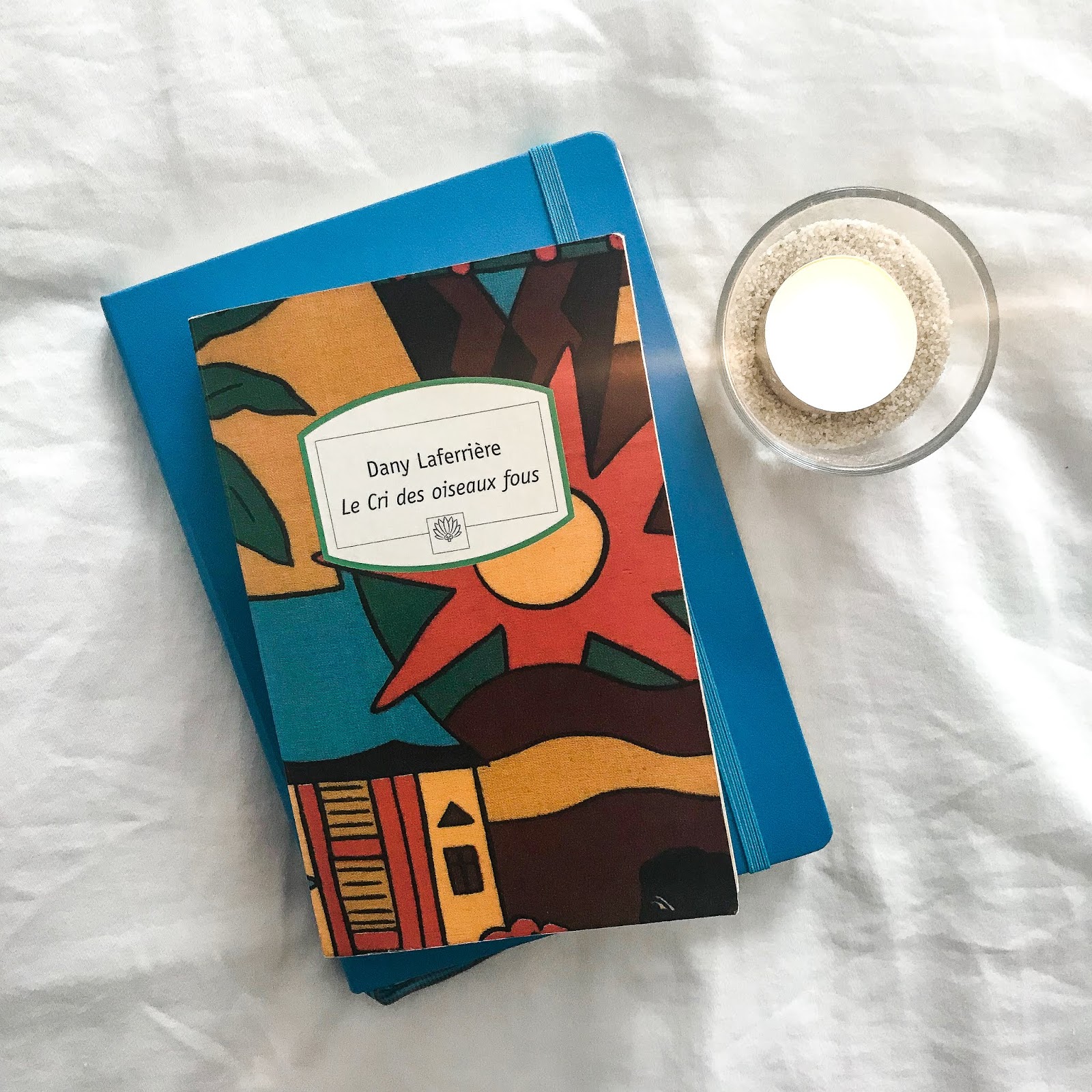
Le Cri des Oiseaux Fous (2000)

This autobiographical novel was first introduced to me in my final year of my Bachelors (2014) in one of my French modules; it was one of the primary texts and one of the first full-length novels in French I was to read. I really enjoyed reading it at the time, and even revising the text during exam season! So I decided to re-read the novel to begin reading more in French again and to see how my relationship with the text has developed. I am writing this review in English for fellow French-reading anglophones, though there is a French version too. 


My edition was published by Le Serpent à Plumes in 2002, though it was originally published by Lanctot Éditeur in 2000. Dany Laferrière's 346-paged novel is divided into short time-stamped chapters during the course of 24 hours, which are the last 24 hours the author experiences in his homeland Haiti before being exiled indefinitely. It is written with a first-person narrative, following the protagonist's thoughts where he offers a very personal perception of people, things and events. I will explore some of the key themes and reflections in the book alongside my own reading experience. 

Vieux Os (Old Bones), La Ferrière's pseudonym, is driven to exile following the unprecedented assassination of his close friend Gasner. This assassination sets the scene of 1976 politics in Haiti, a country living under the harsh dictatorship of Baby Doc (Jean-Claude Duvalier) which is in itself a legacy of Papa Doc (Francois Duvalier). Therefore this a highly political novel, as we learn much about the culture and lifestyle this dictatorship creates. Vieux Os compares the two dictatorships with the latter seemingly even more corrupt than the former, yet both with their own approach to brutality and control. Such torture and suffering is no doubt feared yet there are notions of whether it is better to be tortured by your own (Haitian government) or by others, referring to suffering at the hands of white people in foreign countries or even during the period of enslavement. Does it matter who is subjecting you to mistreatment?

Gasner's assassination raises many reflections on the nature of friendship and various types of friendships that Vieux Os holds close to his heart. We learn the secret "codes" they hold between themselves as well as the rarity of good, safe friendships in a world ridden with spies, traitors and "tonton macoutes", the dictatorship's police force. Since friendship is the catalyst for exile in many ways, it cannot go without analysis in our very contemplative protagonist's mind. 

As we learn about Haiti's culture through our protagonist, we are soon exposed to its unique religious environment where two dominant religions reside: Catholicism and Vaudou (or Vodou). This religious dichotomy not only represents ancient practises versus colonial teachings, it also shows different approaches to faith and seeking strength and hope in the tense environment. Laferrière does not shy away from intertwining Vaudou gods or beliefs in his writing, even in subtle ways when recalling his deceased friend thus engaging the reader with the religion.

Women play an important role in Haiti and in Vieux Os' last day in the country. We are introduced to many different types of women, from the saintly, grief-stricken mothers to vulgar temptresses and many somewhere on the spectrum between those extremes. Thus Laferrière explores lust and temptation as well as love and commitment. We learn how women are integral to keeping homes and the country running, as men are so often being persecuted. Laferrière shines a light on the strength of womanhood in such extreme conditions. 

The novel also delves into the world of prostitution, a strategic industry nurtured by the dictatorship to contribute to weakening the population. Moreover, prostitutes have access to a world of deep, dark secrets and are thus valuable sources. In some ways we see the human side of such a vulnerable and potentially brutal career.

Overall, I found it a pleasure to read this autobiographical novel. Laferrière explores a vast range of themes connected to his life and nation from family and friendship to life and death. Because this novel is based on the author's real life experiences and many of the characters are presumed to be real to some capacity or another, I was left with the desire to know more about what happened to the author himself and his parents- which would mean I need to look for the corresponding books in his long series. I enjoyed the writing style as I found it amusing in places, which balanced out some of the sorrow

***

Have you read this novel? What did you think of it? Comment your thoughts below, I'd love to hear what you thought. 

*** 

Follow me on instagram @nafisasiddique for updates on my latest posts.

Le Cri des Oiseaux Fous (2000) - français

Ce roman autobiographique écrit par Dany Laferrière m'a été présenté pour la première fois pendant ma licence de français. Il m'avait beaucoup plu à l'époque et je voulais le lire à nouveau afin de voir si mes impressions ont changé depuis. Mon édition est celle du “Serpent à Plumes” de 2002, mais le roman a été publiée une première fois par Lanctot Éditeur en 2000. Cette oeuvre de 346 pages est divisée en petits chapitres horodatés, en poursuivant les dernières 24 heures à Haiti avant l'exil indéfini de l'auteur. Il est écrit à la première personne et suit les pensées profondes du protagoniste qui propose des réflexions très personnelles à propos des choses, des gens et des événements. J'examinerai plusieurs thèmes importants et donnerai ma réaction personnelle dans ce compte-rendu. 


Vieux Os, le pseudonyme de l'auteur dans le roman, est obligé de partir de son pays en exil après l'assassinat de son ami proche, Gasner. Les assassinats et l'exil sont des circonstances bien connues dans le contexte politique de Haiti sous la dictature de Baby Doc (Jean-Claude Duvalier), héritier du pays après le décès de son père Papa Doc (Francois Duvalier). Il s'agit donc de la politique de la dictature et ses conséquences dans la culture nationale. Vieux Os compare les deux dictatures où la première semblait être moins corrompue que la seconde, mais où chacune a eu sa manière de surveillance et de brutalité sur le peuple. Une réflexion approfondie amène la question importante suivante : vaut-il mieux être torturé par les siens (son propre gouvernement ou ses congénères) ou par des étrangers (rappelant l'oppression de l'esclavage, la colonisation et même la domination raciale)? Comment cela importe-t-il? 

En perdant soudainement un ami proche, Vieux Os se retrouve à analyser ses amitiés variées qu'il tient à coeur. Nous apprenons ses "codes" privés entre amis et aussi comment les bonnes amitiés, sans danger, sont si rares dans un monde rempli d'espions, de traîtres et de tontons macoutes, la police de la dictature. Les réflexions à propos de l'amitié de notre protagoniste contemplatif ne peuvent être ignorées car l'amitié est le catalyseur même de son exil.

La culture de Haiti révèle un environnement religieux unique qui consiste de deux religions principales: le Catholicisme et le Vaudou. Ces deux religions représentent à la fois les anciennes pratiques et les enseignements coloniaux; nous voyons aussi des approches différentes pour trouver l'espoir et la force dans les conditions difficiles. Laferrière entrelace son histoire avec les dieux et les croyances Vaudou de manière subtile et évidente. 

Les femmes jouent un rôle important dans le pays et durant les dernières 24 heures de Vieux Os dans le pays. Il nous présente des femmes de toutes sortes, des mamans angéliques accablées de douleur aux séductrices impétueuses, et toute une variété entre ces deux extrêmes. Ainsi, Laferrière nous présente une exploration du désir et de la tentation ainsi que l'amour pur et l'engagement. Les femmes semblent faire fonctionner le pays et leurs maisons pendant que les hommes font face à la persécution politique, ce qui souligne la force de la féminité dans des conditions extrêmes.

Le roman plonge aussi dans le monde de la prostitution, un secteur stratégique de la part de la dictature pour affaiblir la population. De plus, les prostituées sont des sources d’informations précieuses grâce à leur accès à un monde rempli des secrets les plus profonds. Nous découvrons aussi un côté humain à une profession tellement vulnérable et potentiellement brutale. 

Dans l'ensemble, le roman était encore une fois un plaisir à lire et j'ai pu l'apprécier différemment cette fois-ci comme mon français s’est amélioré. Laferrière étudie un grand nombre de thèmes liés à sa vie et son pays, de la famille et l'amitié à la vie et la mort. La présence de passages amusants compense la tristesse poignante. Parce que ce roman est inspiré de la vie réelle de l'auteur, je me suis retrouvée extrêmement curieuse de la suite des événements surtout par rapport à ses relations avec ses parents. Cette curiosité me poussera à chercher les romans correspondants que Laferrière a écrit.   

***

Est-ce que vous avez lu ce roman? Comment vous l’avez trouvez? J’aimerais bien lire vos pensées ci-dessous! 


Tuesday, 3 December 2019

Rich People Problems (2017)

Rich People Problems is the final novel in the trilogy by Kevin Kwan, published in 2017 by Doubleday (Penguin). My digital edition was 393 pages (paperback 384 pages) and the novel was divided into four parts with a total of 56 chapters with added prologue and epilogue. I will share my thoughts on the content, form and generally compare it to the two preceding novels. 


Kwan chooses to play with his writing in this novel by keeping some elements the same (chapters headed by locations) but also offering the readers more "first-hand" information from sources like magazine articles, adverts and other literary sources. This, as well as the different focuses Kwan offers in each chapter, provide a range of perspectives for the reader in an intertwined plot. Kwan pulls this off really well and it keeps the novel dynamic and engaging. He competently adapts his writing styles to the literary sources, from diary entries to gossip articles and they help to make the reader feel more involved with the whole intrigue. A few new settings (especially in India) added a new flavour to the range of experiences he described too, and I definitely appreciated those brief "visits". 

As far as the storyline goes, Rich People Problems gave me what I wanted (to develop the story between Nick and his grandmother- and Tyersall Park) and much more. Kwan manages to combine and tie up both the first and second novels extremely well. It justifies and compensates the second novel, for China Rich Girlfriend does provide a fair amount of background for half of this novel's story. I found this final story to be extremely eventful, which offered a good pace to all the happenings. Kwan managed to keep the balance between creating suspense and filling scenarios with emotion without them lingering on for too long and allowing the reader some relief or at least some progress on the issue(s) at hand. 

I also valued Kwan's approach to history in this novel. Crazy Rich Asians and Rich People Problems offer a colonial context to Singapore, especially in its architecture, but I liked how Kwan went the extra mile in this novel. By taking the reader into the past, Kwan characterised Su Yi more thoroughly as well as deepen our understanding of the relationships in the novel. 

Overall, I have to say I loved this book as much as the first one and it gave me much more than what I was expecting. I'm glad I chose to read the final of the trilogy despite the slight "slump" in the middle. Believe it or not, this novel shows that rich people do have a whole host of problems. Ranging from being accepted into high society to inheritance and being released of the "shackles" of elite norms, Rich People Problems definitely offers readers an enjoyable and emotional experience into this wealthy world.

***

Have you read this novel? What did you think of it? Comment your thoughts below, I'd love to hear what you thought. 

*** 

Follow me on instagram @nafisasiddique for updates on my latest posts. 

Monday, 25 November 2019

The Watermelon Boys: A Novel (2018)

When I found out that my brother’s best friend’s sister had published a book, I had to get my hands on it, albeit a year late. Since, this novel has received the Betty Trask Award. The Watermelon Boys by Ruqaya Izzidien is a 349-page novel (or 352 with the Author’s Note) published in 2018 by Hoopoe, Cairo. It comprises of 57 chapters divided into three parts. I’ll firstly note the details of her award and include the book’s description (or blurb) before going into my review. Note, I read this novel in April 2019 and just gotten round to publishing my thoughts now.

Izzidien’s novel is one of the six winners of the 2019 Betty Trask Awards, bestowed annually by the prestigious Society of Authors’ Awards in recognition of the best and most promising first novels written by authors under the age of 35 in a traditional or romantic, but not experimental, style. (Source below)


Book description:
It is the winter of 1915 and Iraq has been engulfed by the First World War. Hungry for independence from Ottoman rule, Ahmad leaves his peaceful family life on the banks of the Tigris to join the British-led revolt. Thousands of miles away, Welsh teenager Carwyn reluctantly enlists and is sent, via Gallipoli and Egypt, to the Mesopotamia campaign. Carwyn’s and Ahmad’s paths cross, and their fates are bound together. Both are forever changed, not only by their experience of war, but also by the parallel discrimination and betrayal they face.


The narrator powerfully begins the novel in the first-person plural (we), implicating each of us into history before switching to a third-person voice, focalising into Ahmad’s experience, but then later also that of Carwyn, To a lesser degree the narrator focalises into other characters’ experiences too. Izzidien chooses an effective writing style for the story she has crafted. She skilfully recounts several tender scenes and also succeeds in creating tension and expressing passion, thus taking the reader through an emotional journey as well as a historical one. The narrator offers deep words of truth and contemplation on several occasions in the novel, which call out the ongoing state of the world and contemporary human relations. Bringing in these reflections and connecting history to the present day serves to spark reflection in terms of what we can learn from history and how much of it we allow to be repeated. It also prevents us from disassociating ourselves from people of the past as mere characters. 


While this novel focuses largely on Ahmed and his sons in the light of historic events, as they are the titled watermelon boys who sell the fruits along the Tigris, we also meet strong female characters. They are gracious and admirable without being clichés or cringingly naive. Izzidien creates a warmth in her female characters, who are both pleasant and powerful in their own ways. I would have loved to delve deeper into their lives, but for that to be satisfied, the novel would have had to be much longer. Thankfully she gives us just enough though more wouldn’t have gone amiss. 

In terms of the historical period, I found that I was reading about a part of British colonisation that I had never known or heard about (having been more exposed to Indian and African narratives). Izzidien proposes a provocative depiction of historical events, which I doubt would be typically read in a British classroom. Izzidien is not afraid to take the British to account in this piece and it is rather refreshing to say the least. This critical exploration makes this novel, in my opinion, a valuable and arguably necessary read for anyone who does not know about British involvement in the region as early as WWI. 

As Izzidien describes a time gone by and a city (Baghdad) that no longer exists as it used to, I could not help but to feel remorse and grief at the architecture, life and how this city, as many others in the world, mark history in the absence of monuments and relics rather that in the solid walls of historic architecture and museums. Thankfully history is also contained in people’s hearts, memories and in literature. Izzidien's descriptions of the city are vibrant and create a longing for a place that unfortunately no longer exits in its fully glory. 

Overall, I found the novel to be both historically informative and emotionally nuanced. I enjoyed reading Izzidien's writing and felt it was a brave piece of work. My biggest criticism would be that I would have liked to read even more about some of the other characters and sub-plots but also recognise that it would have been beyond the scope for a first novel.  

Source: https://hoopoefiction.com/2019/06/19/izzidiens-first-novel-the-watermelon-boys-wins-big/

Have you read this novel? What did you think of it? Comment your thoughts below, I'd love to hear what you thought. 

*** 

Follow me on instagram @nafisasiddique for updates on my latest posts. 

Tuesday, 14 August 2018

Homosexuality in Islam: Critical Reflection on Gay, Lesbian, and Transgender Muslims (2010)

Homosexuality n Islam: Critical Reflection on Gay, Lesbian, and Transgender Muslims by Scott Siraj al-Haqq Kugle was published by Oxford Oneworld in 2010. It is a non-fiction text that comes to 275 pages (main body) but goes up to 335 including the notes, bibliography. glossary and index, which illustrates the extent to which this text is well-researched and comprehensive. I will highlight some of the key arguments in the text, divided by chapter, and provide my own thoughts on how convincing Kugle's argument is. 


Kugle begins his work with a case study to contextualise the need for this research and the social repercussions of publicly acknowledging a gay sexual orientation. By the end of the book he brings to the fore his engagement with contemporary realities (in terms of the legalisation of same-sex marriage in secular countries) and how Muslims of different sexual orientations and gender identities live and negotiate their life and faith in relation to these matters. 

He highlights the methods of coming to Islamic legal rulings and how they are negotiated, from Quran, hadith (reports of the Prophet Muhammad's words and actions) and reasoning of the various major schools of thought. These are divided into separate chapters. He makes the following significant points made in the respective chapters. "Liberating Quran: Islamic Scripture" points out that the story of Lot does not condemn gay people, as the crimes of Lot were not limited to sodomy and if their crimes included this element, it condemns rather the violence of the action. Furthermore, laws of previous nations are not necessarily applicable to Islamic law, as is the case for many other matters. "Critiquing Hadith: Islamic Oral Tradition" notes that there is no prophetic example to follow in terms of same-sex relationships (punishments or otherwise). It also highlights the prevalence of weak or fabricated hadiths. "Assessing Fiqh: Islamic Legal Reasoning" competently compares the logical reasoning behind the various schools of thought and thus explains their differing stances on same-sex sexual acts in relation to illegal heterosexual sex. Through these chapters he deals with the notions of prejudice, bias and inconsistency which then inform legal interpretations. 

From these criticisms and analyses, Kugle goes on to offer his own suggestions on how to address same-sex relationships in contemporary society. In his chapter "Reforming Shari'a: Islamic Ethics of Same-Sex Marriage" he offers the possibility of legalising same-sex marriage in the Muslim community and argues how such a shift in approach to nikkah contracts will also benefit women (and feminists) as well as gay Muslims. His argumentation is compelling and informed, as he deconstructs the reasons not to do so competently. 

Kugle's transgender argument is much shorter, being limited to the one chapter: "Reviving Spirit: Islamic Approaches to Transgender Experience" and is, for me, less convincing outside the frame of hermaphrodites. When I say "less convincing", that is not to contest Kugle's case for fair, human and compassionate treatment of people who choose to identify with another gender (and even surgically change their body with this intention), rather I mean that I do not know how such a decision can be deemed more than a "whim" in the Islamic perspective, and correspond to the essentialist notion of sexuality and gender that Kugle adopts. It is a complex matter and it requires more study, which Kugle at least offers a starting point for. 

To conclude, Homosexuality in Islam: Critical Reflection on Gay, Lesbian, and Transgender Muslims that provides essential insights into the contemporary reality of homosexual and transgender Muslims in the light of Islamic understanding. It explores the conflicts gay Muslims face due to cultural and social forces prejudicing Islamic interpretation and consequently human treatment of homosexuals. He offers strong and convincing arguments for his case, especially for gay Muslims, and does so by breaking down the multiple components that inform Islamic legal jurisprudence. Due to this, this book also provides much information and insight, for those who do not know, into the workings of the Islamic law (or shari'ah) and its many nuances- obviously with a limited focus on this topic. 


***


For updates on my reviews, follow me on instagram @nafisasiddique 

Saturday, 12 May 2018

The Translator (1999)

The Translator by Leila Aboulela is one of my primary texts for my Masters thesis (in progress) so although I may discover more interesting interpretations and analysis through the course of my research, I thought I would share a quick review of the novel now. It was first published in 1999 but my edition is from 2008, published by Polygon. This was Aboulela's first novel and is 196 pages and 23 chapters long. I will explore some of the key themes of the novel as well as its socio-historical significance. I will also briefly discuss the choice of genre but firstly I will add the blurb of the novel. 

The Translator is a story about love, both human and divine. Sammar is a young Sudanese widow, working as an Arabic translator at a British university. Following the sudden death of her husband and estrangement from her young son, she drifts- grieving and isolated. Life takes a positive turn when she finds herself falling in love with Rae, a Scottish academic. To Sammar, he seems to come from another world and another culture, yet they are drawn to each other. 


As indicated above, this is a novel of love, loss and healing where faith plays a central role. Sammar marries her childhood sweetheart and first cousin, Tarig but after his death she has to renegotiate her notion of love and heal herself in order to be able to love again. Aboulela manages to write about the grieving process in a delicate and careful manner and illustrates some of the "extreme" decisions that may be taken in grief but also shows how invaluable a strong support network is, since her trauma meant that she was incapable of being a mother to her child. Slowly she reveals what she considers to be some of the underlying factors in love, such as gratitude, feeling understood, respected and safe. 

The relationship between the East and the West is a strong theme in the novel. Aboulela deals with the Orientalist tension, which is voiced via her colleague Yasmin, and attempts to remove the division between the two worlds by indicating a "crossing" or exchange of the two. While Yasmin is critical of Western academia, Sammar attempts to engage with it (via Rae) to deepen the understanding of Islam in the Western context. This is while Sammar herself negotiates her faith and its practise in the secular context of Aberdeen and the culture shock of enjoying practising her faith freely and openly in Sudan to the secret prayers in the UK. This theme highlights the central role of religion in a practising Muslim's everyday life, as opposed to it being a random disposable hobby. The importance of faith is highlighted again when Sammar is faced with the reality of her situation: that she loves a non-Muslim man, who she cannot marry unless he converts. This predicament is in many ways symbolic of the relationship between the East and the West and it challenges contemporary notions of romance and the romance narrative. 

In terms of the writing style itself, Aboulela writes in a largely linear chronology, making use of occasional flashbacks and memories to fill in gaps in the reader's knowledge. The novel is narrated with a slow and careful pace with a third person voice with the majority of the novel focalised from Sammar's perspective and occasionally from Rae's. In terms of genre, it parallels Jane Eyre and the nineteenth-century domestic novel in many ways, although Aboulela clearly adapts the story to suit the changed context and protagonists. 

This novel, having been published in 1999, illustrates the tense relationship the West has had with Islam from before a 9/11 era, which people often use as the benchmark of when islamophobia began. Although 9/11 may have led to increased discrimination towards Muslims, there is a deeper history behind hostility towards Muslims and it goes beyond simplistic conclusions of one or two terrorist attacks. This novel strongly implies the difficulties Muslims in the West have to face in order not to perpetuate imposed stereotypes and for how long these stereotypes have existed. 

Overall, this novel is a serious, calm and sombre reflection of the experience of a Muslim woman in Britain. The secular prejudice that is criticised in the novel, still exists in academia today, almost 20 years later, thus making it relevant to contemporary struggles. The Translator challenges Orientalist discourse but does not seek to create a divide between the East and the West but rather looks at positive exchange and a new approach to their relationship. It was a thoughtful novel that quietly dealt with deep social and personal issues. I personally found that the technological restrictions of the time illustrated the nature of patient perseverance and it added an extra charm to the relationship.  

***

Have you read this novel or anything else by Leila Aboulela? What did you think? Let me know in the comments below or message me via instagram. 


Follow me on instagram @nafisasiddique to find out when I post new reviews.

Tuesday, 3 October 2017

milk and honey (2015)

Milk and honey was published by Andrews McMeal Publishing in 2015 and consists of 206 pages of poetry, divided into four chapters: the hurting, the loving , the breaking, the healing, with an additional two pages, one about the book and one about Rupi Kaur. The format of the book is black and white, including several black pages with white print. Kaur includes several of her own illustrations alongside her poetry to complement her words.


I finally decided to jump on the bandwagon, albeit far too late. The reason for this review and even reading milk and honey in the first place was my sister's references to the book, her underwhelmed opinion and her seeking my thoughts on the matter. Naturally I wasn't quite in a position to give a fair opinion on Kaur's work without having read it. So now here we are. No doubt I had heard a lot about this book and consequently I went in expecting a certain kind of narrative. I also know that Rupi Kaur's work seemed to bring joy to many women of colour. I'll describe what she writes about, how she writes, the nature of love in her work and some references to her work as a woman of colour.

Kaur uses highly emotional language in her poetry to evoke strong feelings in her readers; she appears to have wholly adopted an aesthetic approach to her writing in order to create an experience of strong sentiments and physical sensations. Kaur covers issues like rape and sexual violence and the silencing of the female voice, including abusive relationships and even angry couples. These images can be taken literally or interpreted metaphorically as various difficulties being faced in life. 

Kaur calls on "self-love", a popular term referring to caring for oneself, to be the foundation of human strength and this comes before loving others or seeking the love of others. There is a consistent desire to be loved, wanted and to belong in these poems and Kaur attempts to balance these desires out with advice on beginning with the self. However, she nonetheless values the search for love and a partner, recognising it as an added strength. 

I was quite surprised at the highly sexualised imagery Kaur used, mainly because I wasn't expecting it. The poetry felt so much about human desires, its wants and needs and they are significantly on carnal and "animal" levels. The strong sexual themes and language, for me, seem like a contemporary "necessity" for success in the arts. I remember once during my Bachelors degree having a class discussion on how it is literary critics who decide whether sexual representations in literature are pornographic or tasteful and artistic. I personally found it a little vulgar and a strategy to pander to a wider audience, considering that mainstream modern Western society is hyper-sexualised and we live in an increasingly promiscuous culture. These themes subsided towards the end of the book. 

Kaur included one poem on mainstream European standards of beauty and highlighting the richness and beauty in Indian and other coloured skin tones. There is one poem on women of colour and then one poem on being a Kaur and Sikhi. She also writes a three-lined poem on seva, selfless service, which is an element of the Sikh religion. While I was glad to read these short poems, I felt they were too little and too discreet. I could not but help compare it to Nayyirah Waheed's approach, which is far more potent as she abruptly condemns her colonisers and their languages. Kaur is far more gentle and doesn't point fingers at the colonisers or the West, which may well have allowed her to enjoy a more white, middle-class audience. 

Towards the end, the book felt like a self-help handbook for women coming out of relationships or difficult periods in their lives, which is useful to those who want to seek solace in it. However, I was somewhat disappointed with this collection of poems because I had hoped for a richer representation of Punjabi and/ or Sikh culture. Not only did I not get these, but I felt the Divine was not referred to at all and these poems were only about humans at their lowest levels, and not the transcendent. Greatness was in the "universe", terms that probably sound lovely to atheist ears. Overall Kaur's writing is definitely provocative and the themes may well resonate well with a mainstream audience but I didn't quite find them to suit my taste nor did I find them particularly uplifting (in a spiritual sense); it was a tad mundane. 

Monday, 11 September 2017

Northanger Abbey (1817)

While the original Northanger Abbey was published in 1817 after the death of Jane Austen, my copy is a Collins Classics edition published in 2010. The novel itself is 230 pages and there are an additional 27 pages of "Words and Phrases from Classic Literature" to help with any unknown terms. I'll give a little insight into my thoughts on the style and some other points of interest raised by Austen. I'll also compare this novel more to Mansfield Park, since I read it not so long ago.


Reading Northanger Abbey straight after Mansfield Park allowed me to make more direct and precise comparisons between the two. While I find the plot of Mansfield Park to be somewhat more complex and with more closely interwoven stories, I can appreciate Austen's not-so-affluent heroines and their relatively more humble family backgrounds in both of these works. That's not to say Austen isn't about high class society, but she plays on the interactions between the various levels in the hierarchy of the gentry.

I found Austen's style in Northanger Abbey to be rather distinct in its more overt sarcasm and wit. I believe the tongue in cheek humour in the descriptions is somewhat more discreet and subtle in some of her other works. To incorporate some Gothic thriller elements into her writing illustrates Austen's engagement with other literature of her time and her own attempts at experimentation with other genres. This is also evident in her significant emphasis on a theatrical play in Mansfield Park, another example of crossing between various art forms. She also overtly discusses the role and nature of novels of the period, especially those written by Anne Radcliffe. Austen opens up this discussion on female writers and attempts to determine where their value in society is in relation to other traditional texts, such as histories, written largely by rich men.

Austen's way of developing characters seemed different from her previous approach, such as in Mansfield Park, where she describes the character for you. I was quite fascinated this time as Austen used her protagonist, Catherine's naiveté to give every other character she interacted with a fair chance to expose themselves through their own words and actions. I found this characterisation intelligent and a refreshing change from a dictated judgement from the narrator. In terms of character, I found the hero in this novel, Henry Tilney, to be fairly likeable excepting his tendency to make general passing judgements on what is appropriate, acceptable and/ or good in the female sex. But it probably represents a fair part of ideal gender roles of the time. Austen chooses to (sarcastically) elaborate on this tendency through her narrator, who enlightens us on the advantages of ladies, especially pretty ones, to remain ignorant in order to flatter the vanity and ego of their conversational partner. Charming tips!

Another similarity between the two novels is that of the rather swift conclusions. I felt that Northanger Abbey's conclusion could have been lengthened and developed a little more as it felt unsatisfactory, considering the sudden plot twist that had to be explained and then resolved. There was little news on James, Catherine's brother, and his future. I personally felt as if Austen needed to quickly create and write her happy ending without wanting to write reams more and thus wrapped up the story in a rushed fashion. I think the emotional challenges in Mansfield Park made the quick conclusion an acceptable relief, yet insufficient in Northanger Abbey since there was less "drama" so to speak.

Overall, it was a less gripping read than Mansfield Park, yet more light and humorous. It was also a much shorter novel, comparatively, which explains the less dense plot, yet Austen still explores a wide range of issues from gender roles, social hierarchy, education, honesty and sincerity as well as the role of literature in relation to real life. She merges the concepts of fiction and reality and this makes for some thought-provoking discussion.


Friday, 25 August 2017

Mansfield Park (1814)

I'm currently catching up on some of the books on my personal reading list now that I have a little break between semesters. I thought I'd begin with Mansfield Park since it's been a while since I've read anything by Jane Austen. This edition was published in 1949 by the Novel Library and is 479 pages long on remarkably thin paper. 


I was surprised to find myself much more captivated by this novel than previous ones I've read (quite long ago), such as Sense and Sensibility and Pride and Prejudice. I'm reconsidering whether I will read them again as a more mature reader or if I'll just put it to Mansfield Park being written after the two above mentioned and thus attribute it to Austen's own matured style.

Austen's novel makes a change from more contemporary fiction in so many ways: the steady chronological style, the value given to religious and moral conduct and the lack of vulgarity. Of course Austen had her own context to consider and the novels reflect this but she clearly has a moral stance and preference in the novel where religion seems like it ought to be valued more sincerely than the upper class can admit. The religious and moral values she advocates include sincerity and humility, which are lacking in high society in favour of material wealth. Despite this critique of the upper classes, Austen demonstrates her partiality to refined upper class etiquette as being indispensable in a truly noble character. This naturally puts the lower classes at a great disadvantage.

A refreshing element in the novel was the insight into the Price family, a family who is considerably less wealthy and "refined" than the principal Bertram family. While it clearly shows the failings of character that can easily pervade with lack of financial means and poor management, it also provides some hope and an incentive for wealthier members of society or a family to take the initiative to help "raise" others in order to increase goodness, or the potential of goodness, in society.

On a less positive note, I felt that the main protagonist in the novel, Fanny, was a little too sensitive, fragile and timid for my liking and it felt like a character that was, although morally correct, difficult to identify with. This, I can argue, also allows Austen to create a perfect, angelic character, which goes against contemporary subjectivity of character, judgement and a general trend for rebellion.

Overall, it was a rather pleasant, almost indulgent, read and I look forward to reading Northanger Abbey in order to increase my exposure to Austen's writing.

Thursday, 18 May 2017

Born A Crime: Stories From A South African Childhood (2016)

Born A Crime: Stories From A South African Childhood is an autobiography written by the comedian Trevor Noah. It was published by John Murray in 2016 and I downloaded it for a mere 99p on my Kindle. I'm usually not one to be interested in the autobiographies or biographies of "celebrities" but having laughed at a few of Noah's sketches in the past (particularly when he started out) and the bargain Amazon tempted me with, I thought I'd give it a chance. And I'm glad I did. The book is 304 pages long and is divided into three parts and a total of 18 chapters, many of which are preluded by passages that provide context to the following events.


When I messaged my sister telling her a little about the book and how I was finding it, she commented on how it's funny how people can write autobiographies before the age of 40 now. She has a point, and yet I don't think Noah was misplaced in taking out the time to write this piece because it's about more than Trevor Noah the personality. I will explain what I mean. Of course Trevor Noah describes his experiences growing up in South Africa but he does this with plenty of insight into South Africa's history, tribal reputations, linguistic histories, as well as his family environment and his mother's dedication in raising him. This means that we learn about the history of a nation and the richness in just a part of its society and are then given a human side of how living through these complex social structures affects people and smaller communities. As well as a historical and social narrative, Noah's other major influence was his mother and this relationship is one of the main reasons I value this book.

Noah recognises that the world in South Africa is quite particular in its culmination of influences and its apartheid regime in relation to many Western countries' experience of the world. Thus, he makes a sincere effort to provide appropriate analogies along the way, which also function as reminders that the West isn't "clean" of certain sins but rather have their own forms of injustice that may well have been highlighted in the apartheid as being "more severe". He isn't afraid to bring up and discuss real, pertinent issues concerning white (light) privilege, male privilege and patriarchy, domestic violence and injustice towards women as well as reasons for crime and criminality and the breeding of hate and racism in a society. These are not problems that are South African problems alone nor are they "the Black man's problems" but rather issues that concern everybody individually as well as collectively.

Having lived in both Britain (born and raised) and Germany (at present), I would like to provide a minor correction to Noah's comparison to the teaching of the apartheid to South African children post-apartheid to the education Germans provide about the Nazis and Britons about the Empire. He rightly remarks that German students are made aware of the events of the Holocaust and share a public shame at this part of their history, but I felt the description of the British teaching of colonialism is slightly misplaced. I don't recall ever being formally taught about colonialism in school and even any reference to the slave trade was cursory and primarily focused on America. Britain hardly feels regret or shame about the Empire and consistently hides or avoids mentioning the huge injustices it committed and the attitude is rather that of "ah yes, the Empire was a big thing we had, and now don't- but now we have the Commonwealth".

In terms of writing style, the book is captivating and fluid. It's a pleasure to read and includes a fair share of humour with its tales of rather amusing and ridiculous events. However the emotions aren't always high and frivolous but varied and sometimes rather upsetting and serious. Noah manages to balance the emotions for it never to be too dark or pitiful nor simply comic. His narrative is personal and intelligent.

Now, I have to say that I love Mrs. Noah, Trevor Noah's mother. She, for me, is the real star and hero of the book. Coming back to my sister's remarks about someone under 40 writing an autobiography, I felt that it was an excuse rather to write about his mother. For me Trevor Noah, the child, was probably too boisterous but generally a decent lad however what I really savoured was Mrs. Noah and her rich personality. She is such a strong, brave woman and repeatedly shows her dedication to motherhood and her principles and values. Her strength of character and physical capacity to chase a little boy like Trevor left me in awe and hope. I'm not going to say I condone all methods practiced but there is much to learn in this book about raising a child and developing a meaningful relationship with your child. Mrs Noah is about instilling values and dedicated so much to simply opening the eyes of her child. She reminds us of motherhood and its sacrifices, its pains and joys, and how to foster a positive, healthy outlook to life even in the face of adversity. Her faith is her core and her faith is what elevates her. I can't say I wouldn't be happy to meet her myself!

To conclude I wanted to mention something concerning the sincerity of the book. I may be naive and blind to ulterior motives but while I recognise that Noah suffered a difficult childhood in so many ways, I didn't feel that this book was written in a bid to seek sympathy or to victimise the comedian. Nor was it, for me, a rags to riches story of hope and dreams. To a large degree I have to say that I'm glad of Noah's material success as far as it allowed me to learn firstly about his mother, secondly about the history and experiences of a segment of South African society and thirdly that he is in a position to discuss and denounce ongoing injustice in the world today. I'm rather tempted to write an essay for my seminar on the book, but we'll see what happens. Finally, I find that Noah's personal experiences are so varied, having engaged with such a variety of people from so many different backgrounds and social classes and this is naturally a great asset to him in his work.

Wednesday, 8 February 2017

Arranged Marriage

It's been a while, I know. I've been a little busy. I've jumped on here to get some thoughts down (and out) about some issues that have been in my mind for a little while. 

I've recently felt an increased sense of frustration at the way in which the West looks down upon Eastern cultures and traditions, and yet still exoticises it in a way to make it seem that they're being respectful or curious. It's rather superficial. My current problem lies in the depiction of marriage and gender relations between the cultures. This is not my only concern but it will be the topic of this post. 

I want to begin here by clarifying some terms so that we're all on the same page. "Western" does NOT mean white. It refers to a mentality and outlook which is pro-modernity and considers the situation of the world a process of progression and development and thus considers modernity to be the current peak, until it gets better and even more modern. This is in contrast to "Eastern" which is a mentality and outlook related to staying true to tradition and realigning oneself to one's original, pure state and thus a "devolution" to a higher state. For a more detailed explanation on these terms, please refer to Réné Guénon's "The Crisis of the Modern World" or "La Crise du Monde Modèrne", in whichever language suits you. 

Another clarification I would like to make is that between a love marriage, an arranged marriage and a forced marriage. In principle we have a love marriage which is where two people meet, fall in love and decide to get married. An arranged marriage is where two people are introduced by someone in their circles (parents, friends, family, community members) and upon getting to know the person each of them willingly accepts to marry the other. What is crucial here is that the man and woman both have the right and the ability to reject a proposal. Their choice is a vital part of the procedure. A forced marriage is where two people are introduced (or not) and are expected to marry due to external factors (social, familial, financial etc.). They have little to no choice in the matter. 

We, as humans, like to categorise things all the time and I will demonstrate how the boundaries of these marriages can sometimes be blurred. An arranged marriage, having the condition that the two people involved are willing to marry, can develop into a perfectly loving marriage and healthy relationship. The couple have the right to make inquiries and make their decision about the match and thus, if they are satisfied and work honestly to a caring relationship, there's no reason why there can't be love in this marriage. A love marriage also can take a turn if the couple, for some reason realise after the marriage that they're a poor match, it can sometimes turn into a situation where they force themselves to stay together and foster a toxic marriage. A forced marriage, being forced, can be doubted even for its validity but if we pretend that this is a valid marriage, there may be occasions where the people forced into the marriage come to a certain understanding to make the relationship work and perhaps this may lead to respect and love in this couple. Of course the reverse is always true, arranged marriages can go horribly wrong and a forced marriage are often traumatic. 

My trouble is the tone in which Westerners speak about arranged marriage. It is associated to a backward and outdated tradition. The West may no longer implement this method in its traditional form but that doesn't mean it has lost its value and place. Westerners see it as a method that no longer applies and is no longer beneficial, which is far from the truth. It goes as far as some Westerners labelling examples of forced marriages as arranged marriages. They seem to feel that arranged marriages are oppressive and thus must be forced in some way. What pains me even more is that there are people in the East who seek to please the West and show them how much they've "progressed" and so go out of their way to illustrate the weaknesses in arranged marriages (because of course like any of the above marriages, an arranged marriage can also be difficult for some) and that they are moving into more modern territory by adopting a Western approach to relationships. Ultimately this is a matter of "hanging out your dirty laundry" and exposing yourself to mockery. I find it painful to watch and, from where I am, to listen to the Western comments around me speak condescendingly about these cultures and traditions which deserve so much more respect. This is from a real experience of a trailer viewing of 'Monsoon Wedding' in a university lecture in Germany. I feel that in many ways this is because some Westernised people in the East are failing to value themselves and suffer from an inferiority complex. To prove that they're "with the times" they are willing to mock the sanctity of marriage. 

Now, arranged marriages are based on a community of trust and insight. There is a general understanding that some people in society are good references of wisdom and insight. It would be a good idea to consult these people about matters concerning big life decisions like marriage because they can guide you and help you. Often these people are considered to be among the elders in the community. However what must be made clear is that I don't believe all elders have the same level of insight and wisdom and thus there are people who are better to go to for advice and those whose advice you should be careful with. There are those who are more likely to make accurate judgements and those who will do so less well. So someone seeking advice needs to seek quality and not quantity (an age), although do not negate people's life experience entirely either; there may well be a kernel of wisdom hidden in there too. This is part of a tradition of trust; trust that the West seems to have lost. Again, the fact that the couple have the right to reject the proposal means that they have to make an informed decision for themselves and take responsibility for it. They cannot blame the parents or whomever else because the final call is theirs. 

I'm not being idealistic about the conditions in the East because I know there are conflicts present that require urgent attention. When talking about the East I am referring predominantly to the South Asian (Indian/ Pakistani/ Bangladeshi) community because I have a better understanding of these cultures and cannot speak on behalf of other cultures, although there may be overlap. There are problems in the East concerning domestic violence, forced marriages, refusing to give women the right to an informed choice, refusing to respect women's rights to act in a way that is authentic to their own sense of self and expecting women to be submissive etc. These problems also include the notions that men believe they have been chosen to implement order and dominate over women, control them and push them to what the men think the women should do, not let women think for themselves and objectify them so that they are only seen for their functional purposes of cooking, cleaning, sex and children. 

While these problems are in the East, they are not inherently Eastern. In fact they are truly against an Eastern mindset of nobility and purity. These issues gain momentum because people have lost sight of the origins and the meaning in their traditions, rituals and ultimately have forgotten the underlying values. The objectification of women and submissiveness (sometimes practical ignorance) of women is not considered noble in any of the three main faiths of the Indian subcontinent (Hinduism, Islam and Sikhism). In fact if they enter the faiths at all, they appear due to a twisted interpretation and disconnectedness otherwise people simply use the name of the faith as an excuse to justify their behaviour. The Hindu goddesses are not considered virtuous because of their functional natures but because of their character, dedication, love, compassion and bravery. The women in Sikh history are hailed as warriors and embody strength and bravery. The women in the Islamic tradition are brave, strong, intelligent and well-informed, curious, educated and pious. Regardless of the women you have in mind from whichever culture, there are so many characteristics that make them great which go far beyond superficial functional, objectified criteria. People (and I don't want this to be about men versus women because women often incite such behaviour towards other women too) allow this injustice to take place because they devalue women and dehumanise them so that they can use them for their own personal benefit or sense of superiority. 

Men, who often assume a role of superiority, do so without necessarily realising the responsibilities on their shoulders. There's nothing wrong with a man being a leader, of a country or a household, providing he's equipped for it and is qualified for the role. Often we do not feel the need to vet the men as we do women, to see if they are up to the job. Men aren't patriarchs because of muscular ability or their size or other superficial criteria. In history and in our traditions we praise men who are brave, noble, wise and fair. They are on the side of justice and truth and defend this with all their might. In history there have also been a good few evil men, the likes of Pharaoh or Ravan (if you want to consider him a symbol of negative man) or other such enemies of Truth, peace and wisdom. Hence, using force or manipulating strategy doesn't make you a stronger person in your dealings with people if you're on the wrong side of the battlefield. We need to remind ourselves to raise, nurture and expect a certain quality of man before he is given the respect and responsibilities given to those who are noble otherwise we are destroying ourselves due to our own poor standards and complacency in regards to quality in character. 

To conclude I want to underline that marriage is something that is considered sacred in many faiths and cultures because, ultimately, it is. It is sacred because of its symbolic signification of harmony of two complementary elements and it is thus a place of mutual growth and increase in goodness, where there ought to be a constant effort to maintain a spiritual balance, similar to that of the harmony one seeks in oneself. It is a form of companionship that is designed to elevate you and grant you dignity. That's not to say everyone must marry, but that we should respect the institution of marriage and not believe we are "advanced" and so must adopt promiscuous behaviour, while glorifying it.