Search This Blog

Sunday, 28 June 2020

The Sultan's Daughter (2020)

An ARC of this fantasy novella, written by P.E. Gilbert was gifted to me in exchange for an honest review. The Sultan's Daughter is a quick read of 11 chapters and around 50 pages. It will be self-published by the author in July 2020 in print edition and kindle edition. I will offer a brief, spoiler-free outline of the novella before addressing a few key themes and my thoughts on how they were addressed. 


The story is a set in a pre-modern, oriental fantasy world, which has its own "Charted Map" found at the beginning of the book. This region forms a kingdom and experiences conflict due to power struggles linked to bloodline but more significantly relating to religious beliefs. The initial scene introduces the dying Sultan in his deathbed bestowing heavy responsibilities onto his daughter's shoulders. The rest of the plot relates to how she executes these last wishes. Gilbert provides several discussion questions at the end of the book to provoke further reflection on some of the plot's themes and events. 

The central theme of the novella is the fight between good and bad, which in this case is between the religiously devout and the religious fanatics of the imaginary faith that believes in Abyars as a deity. It is striking that the "hardline" Aybars' laws include lashing for fornication and cutting off hands for stealing and one of their erroneous desires is to want to wage a holy war to regain access to the holy city of Zenith. These parallels to things attributed to some Muslims and/ or governments or groups is hard to ignore. Ultimately we find two Eastern sects fighting each other for faith-based reasons, and these oppositions are not particularly nuanced or subtle. Interestingly the good side, show little evidence of actual devotion. There is much political commentary to be made in this respect, but I will not delve into this in this post. 

As the title suggests, this novella is about a young woman, namely Nalini, who is the Sultan's daughter. Nalini's character evolves significantly through the rapid turns of events.  She begins as a rather submissive and overly-obedient daughter. She later develops into a determined and, arguably, stubborn, albeit insecure, character. Personally, I did not find her character to be amiable. While I admit that not all protagonists need to be beautiful, I found it noteworthy that Nalini is described as one with "little beauty" and has a "darker complexion" than her husband Emilio, the fair-skinned heathen, who happens to be a more sympathetic character than Nalini herself. These characterisations are problematic especially when considering a post-colonial reading of texts. 

Moreover, with a largely male character cast and central female protagonist, there appears to be an attempt to assert feminine empowerment. This power is bestowed upon a woman by men, and Nalini is hesitant to accept it but does so mainly because it is not prohibited in the religious laws. While she is hard-working and demonstrates immense self-restraint, sometimes it is to unhealthy degrees and makes me question her actual competence. She seems to go from being an extremely passive feminine stereotype to someone trying to avoid association to femininity through any expression of weakness. In my opinion she is yet to reach her full potential by the end of the story. This transition of feminine expression requires more depth and nuance. 

The writing style of the novel is fluid. Gilbert makes use of a third-person narrator who focalises into Nalini's experience of events. In this respect, the novella's perspective is highly influenced by her subjectivities, including her inner turmoil and outer appearances. Due to this dual access, it is easier to criticise her more precisely than the other characters. I found Gilbert's discussion questions to be a a nice way to engage more thoughtfully in a short read. 

Overall, the novella was a quick read, with an eventful plot. In some ways it seems like it is not just an oriental fantasy but also an orientalist fantasy. Gilbert deals with major, complex issues and the length of the work may have been a restriction in fully exploring them with due justice. I would like to thank the author P.E. Gilbert for the opportunity to honestly review his hard work.

***

Is this a novella genre that interests you? What do you normally like to read? Comment your thoughts below, I'd love to hear about your reading preferences. 

*** 

Follow me on instagram @nafisasiddique for updates on my latest posts. 

Thursday, 28 May 2020

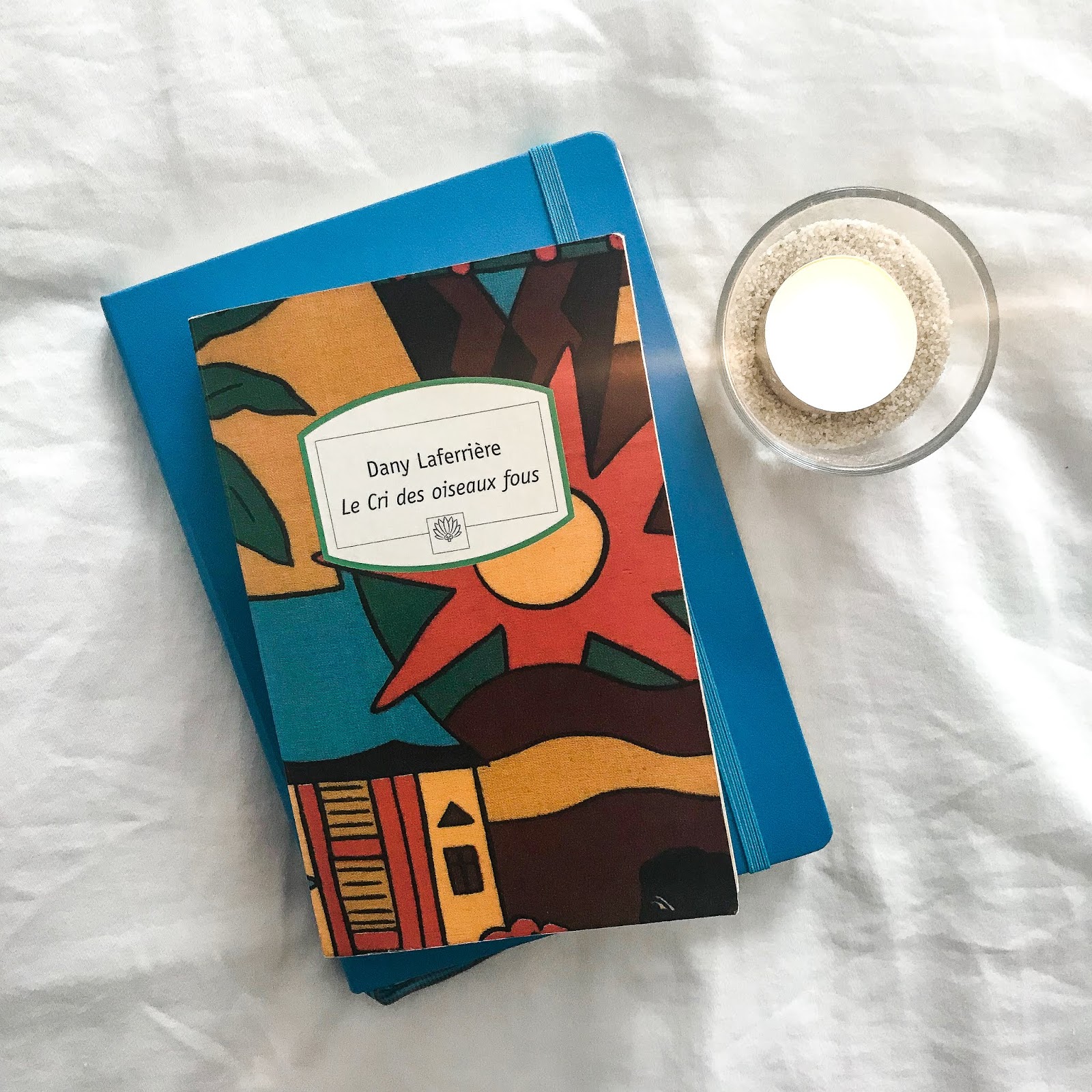
Le Cri des Oiseaux Fous (2000)

This autobiographical novel was first introduced to me in my final year of my Bachelors (2014) in one of my French modules; it was one of the primary texts and one of the first full-length novels in French I was to read. I really enjoyed reading it at the time, and even revising the text during exam season! So I decided to re-read the novel to begin reading more in French again and to see how my relationship with the text has developed. I am writing this review in English for fellow French-reading anglophones, though there is a French version too. 


My edition was published by Le Serpent à Plumes in 2002, though it was originally published by Lanctot Éditeur in 2000. Dany Laferrière's 346-paged novel is divided into short time-stamped chapters during the course of 24 hours, which are the last 24 hours the author experiences in his homeland Haiti before being exiled indefinitely. It is written with a first-person narrative, following the protagonist's thoughts where he offers a very personal perception of people, things and events. I will explore some of the key themes and reflections in the book alongside my own reading experience. 

Vieux Os (Old Bones), La Ferrière's pseudonym, is driven to exile following the unprecedented assassination of his close friend Gasner. This assassination sets the scene of 1976 politics in Haiti, a country living under the harsh dictatorship of Baby Doc (Jean-Claude Duvalier) which is in itself a legacy of Papa Doc (Francois Duvalier). Therefore this a highly political novel, as we learn much about the culture and lifestyle this dictatorship creates. Vieux Os compares the two dictatorships with the latter seemingly even more corrupt than the former, yet both with their own approach to brutality and control. Such torture and suffering is no doubt feared yet there are notions of whether it is better to be tortured by your own (Haitian government) or by others, referring to suffering at the hands of white people in foreign countries or even during the period of enslavement. Does it matter who is subjecting you to mistreatment?

Gasner's assassination raises many reflections on the nature of friendship and various types of friendships that Vieux Os holds close to his heart. We learn the secret "codes" they hold between themselves as well as the rarity of good, safe friendships in a world ridden with spies, traitors and "tonton macoutes", the dictatorship's police force. Since friendship is the catalyst for exile in many ways, it cannot go without analysis in our very contemplative protagonist's mind. 

As we learn about Haiti's culture through our protagonist, we are soon exposed to its unique religious environment where two dominant religions reside: Catholicism and Vaudou (or Vodou). This religious dichotomy not only represents ancient practises versus colonial teachings, it also shows different approaches to faith and seeking strength and hope in the tense environment. Laferrière does not shy away from intertwining Vaudou gods or beliefs in his writing, even in subtle ways when recalling his deceased friend thus engaging the reader with the religion.

Women play an important role in Haiti and in Vieux Os' last day in the country. We are introduced to many different types of women, from the saintly, grief-stricken mothers to vulgar temptresses and many somewhere on the spectrum between those extremes. Thus Laferrière explores lust and temptation as well as love and commitment. We learn how women are integral to keeping homes and the country running, as men are so often being persecuted. Laferrière shines a light on the strength of womanhood in such extreme conditions. 

The novel also delves into the world of prostitution, a strategic industry nurtured by the dictatorship to contribute to weakening the population. Moreover, prostitutes have access to a world of deep, dark secrets and are thus valuable sources. In some ways we see the human side of such a vulnerable and potentially brutal career.

Overall, I found it a pleasure to read this autobiographical novel. Laferrière explores a vast range of themes connected to his life and nation from family and friendship to life and death. Because this novel is based on the author's real life experiences and many of the characters are presumed to be real to some capacity or another, I was left with the desire to know more about what happened to the author himself and his parents- which would mean I need to look for the corresponding books in his long series. I enjoyed the writing style as I found it amusing in places, which balanced out some of the sorrow

***

Have you read this novel? What did you think of it? Comment your thoughts below, I'd love to hear what you thought. 

*** 

Follow me on instagram @nafisasiddique for updates on my latest posts.
Le Cri des Oiseaux Fous (2000) - français

Ce roman autobiographique écrit par Dany Laferrière m'a été présenté pour la première fois pendant ma licence de français. Il m'avait beaucoup plu à l'époque et je voulais le lire à nouveau afin de voir si mes impressions ont changé depuis. Mon édition est celle du “Serpent à Plumes” de 2002, mais le roman a été publiée une première fois par Lanctot Éditeur en 2000. Cette oeuvre de 346 pages est divisée en petits chapitres horodatés, en poursuivant les dernières 24 heures à Haiti avant l'exil indéfini de l'auteur. Il est écrit à la première personne et suit les pensées profondes du protagoniste qui propose des réflexions très personnelles à propos des choses, des gens et des événements. J'examinerai plusieurs thèmes importants et donnerai ma réaction personnelle dans ce compte-rendu. 


Vieux Os, le pseudonyme de l'auteur dans le roman, est obligé de partir de son pays en exil après l'assassinat de son ami proche, Gasner. Les assassinats et l'exil sont des circonstances bien connues dans le contexte politique de Haiti sous la dictature de Baby Doc (Jean-Claude Duvalier), héritier du pays après le décès de son père Papa Doc (Francois Duvalier). Il s'agit donc de la politique de la dictature et ses conséquences dans la culture nationale. Vieux Os compare les deux dictatures où la première semblait être moins corrompue que la seconde, mais où chacune a eu sa manière de surveillance et de brutalité sur le peuple. Une réflexion approfondie amène la question importante suivante : vaut-il mieux être torturé par les siens (son propre gouvernement ou ses congénères) ou par des étrangers (rappelant l'oppression de l'esclavage, la colonisation et même la domination raciale)? Comment cela importe-t-il? 

En perdant soudainement un ami proche, Vieux Os se retrouve à analyser ses amitiés variées qu'il tient à coeur. Nous apprenons ses "codes" privés entre amis et aussi comment les bonnes amitiés, sans danger, sont si rares dans un monde rempli d'espions, de traîtres et de tontons macoutes, la police de la dictature. Les réflexions à propos de l'amitié de notre protagoniste contemplatif ne peuvent être ignorées car l'amitié est le catalyseur même de son exil.

La culture de Haiti révèle un environnement religieux unique qui consiste de deux religions principales: le Catholicisme et le Vaudou. Ces deux religions représentent à la fois les anciennes pratiques et les enseignements coloniaux; nous voyons aussi des approches différentes pour trouver l'espoir et la force dans les conditions difficiles. Laferrière entrelace son histoire avec les dieux et les croyances Vaudou de manière subtile et évidente. 

Les femmes jouent un rôle important dans le pays et durant les dernières 24 heures de Vieux Os dans le pays. Il nous présente des femmes de toutes sortes, des mamans angéliques accablées de douleur aux séductrices impétueuses, et toute une variété entre ces deux extrêmes. Ainsi, Laferrière nous présente une exploration du désir et de la tentation ainsi que l'amour pur et l'engagement. Les femmes semblent faire fonctionner le pays et leurs maisons pendant que les hommes font face à la persécution politique, ce qui souligne la force de la féminité dans des conditions extrêmes.

Le roman plonge aussi dans le monde de la prostitution, un secteur stratégique de la part de la dictature pour affaiblir la population. De plus, les prostituées sont des sources d’informations précieuses grâce à leur accès à un monde rempli des secrets les plus profonds. Nous découvrons aussi un côté humain à une profession tellement vulnérable et potentiellement brutale. 

Dans l'ensemble, le roman était encore une fois un plaisir à lire et j'ai pu l'apprécier différemment cette fois-ci comme mon français s’est amélioré. Laferrière étudie un grand nombre de thèmes liés à sa vie et son pays, de la famille et l'amitié à la vie et la mort. La présence de passages amusants compense la tristesse poignante. Parce que ce roman est inspiré de la vie réelle de l'auteur, je me suis retrouvée extrêmement curieuse de la suite des événements surtout par rapport à ses relations avec ses parents. Cette curiosité me poussera à chercher les romans correspondants que Laferrière a écrit.   

***

Est-ce que vous avez lu ce roman? Comment vous l’avez trouvez? J’aimerais bien lire vos pensées ci-dessous! 


Monday, 20 April 2020

Lords of the Horizons: A History of the Ottoman Empire (1998)

Lords of the Horizons: A History of the Ottoman Empire by Jason Goodwin was first published in 1998 by Chatto & Windus. The edition I read was published by Vintage (Random House) in 1999. My kindle edition comprises of 370 pages and it is divided into three parts, a total of 25 chapters with added Epilogue, a list of Ottoman Sultans, an Ottoman Chronology and Glossary at the end. This review is exceptional and I hesitated whether to write it at all, since I have not finished reading the whole book, and may not ever do so. However, I thought my reasons for halting this read were sufficient enough to be mentioned in a brief review. I will note my intentions for reading it as well as how I found it and why I stopped. 


My sister suggested we start a bookclub during our social distancing and self-isolation practises. With my brother also in the group we decided to read this book as it was on his "to-read" list as he had heard many good things about it and how it provided a good insight into Ottoman/ Turkish history. I agreed to this book because this period of history also interests me, yet I know little to nothing about it. It was also one of the cheaper options on the kindle bookstore (compared to our other candidates). I preferred the kindle option to avoid delivery logistics (waiting and over-burdening the system in this unusual climate). 

An initial critique of the book is that Goodwin failed to describe the context of Europe or Asia prior the Ottoman Empire, thus making it difficult to understand in which environment this empire emerged and how it changed the landscape of these places. We learn that the contemporary world still holds relics of this time gone by but unfortunately there is no real reference to the state of the world before Osman took power. 

In addition to this, it is also a massive shame that the root of the Empire, its values, its raison d'être and the character of its founder are hardly explored. This is apparently due to the seemingly little amount of information there is about Osman I but it seems unusual and like there was not enough justice done to discovering the foundational character of such a significantly powerful and old empire. The first two to three Ottoman leaders were not discussed in any great detail, which would have been of great interest and also would have better marked the distinction between the tribal origins to the sultanate that was later formed.  

It took me a couple of chapters to get into the writing style, but even then I found it less than engaging and far from captivating. I recognise that the Ottoman Empire spans over a vast amount of time (dating from 1300 to 1924) so this book made for an immense project in itself and it would be hardly possible to get into the minutia but even core events in the chronology were not written in a engaging manner. It felt haltingly described and somewhat patched together. In this sense I would disagree with the Time Out review that claimed that this book was "Perhaps the most readable history ever written". My sister also noted that the spelling of the names of the Ottoman leaders were inconsistent between the chronology and the actual book and were thus a tad confusing. 

When we changed books, I considered reading it alongside anyway, to not leave a book unfinished but then I decided against it because of the orientalist attitude and the misinformation shared by the writer. Three core examples of this include: 1) Goodwin attempts to describe the reason for the Sunni-Shi'a conflict and gets it completely wrong: he claims it is due to a disagreement about the Prophetic lineage coming from Ali or Fatima. (They do not disagree on this at all but differ as to whether Ali or Abu Bakr should have been the Caliph after the Prophet's demise). 2) He calls the Kaaba "the weird stone cube", which is highly disrespectful and inappropriate language. This is the direction of worship for all Muslims and marks a sacred geographical, historical and spiritual point in the world. 3) Goodwin describes the Black Stone, a corner stone in the Kaaba, as "God's eye on earth". No sane Muslim has every believed or claimed such a thing, and it is definitely not understood to serve this purpose at all. It is considered to be a sacred stone from the heavens that was initially white then darkened with the sins of mankind. It also is known to have no power, but is revered because the Prophet Muhammad showed respect towards it (i.e. kissed it). 

Since history books are an interpretation of historical events, that are substantiated through documental or other evidence, I felt like I could not really trust Goodwin's interpretation of a history I already know very little about given that he so blatantly made huge gaffes and showed his negative bias in this way. This is the main reason I did not continue reading his work, nor would I recommend it to others.

Admittedly, I only read a small percentage (my kindle told me 20%) of the book, and if my bookclub buddies had decided to proceed with the book, I would have gone along reading it. But since I did not have this commitment, I could not fully trust Goodwin's version of events, nor did I enjoy his writing style, I abandoned ship. 

***

Have you read this book? What did you think? Have you ever found yourself abandoning a book? What made you do it? Let me know in the comments. 


***

Follow me on instagram @nafisasiddique for updates on my latest posts

Monday, 23 March 2020

Extreme Economies: Survival, Failure, Future - Lessons from the World's Limits (2019)

I was honoured with a gifted copy of this book as my sister was a research assistant for the author, Richard Davies. I'm reviewing it, as with all my reviews, primarily as a personal record of my thoughts of the book and secondly to share my impressions with others who seek to read or may have already read the book in order to provoke constructive discussion. This non-fiction work was published by Transworld Publishers, Bantam Press (Penguin). I have a hardback copy, which comprises of 337 pages (without Notes and References) although the book is also available as an e-book and audiobook. I will discuss the structure of the book as well as the writing style and recurring themes or "lessons". 


Extreme Economies: Survival, Failure, Future - Lessons from the World's Limits is divided into three main parts, as the title suggests. Each part uses three case studies to illustrate distinct extreme scenarios. The first part explores "Survival: The Economics of Resilience", which is explored through three locations namely Aceh, Zaatari and Louisiana. The second part delves into "Failure: The Economics of Lost Potential", covering Darien, Kinshasa and Glasgow and finally, the third part examines the "Future: The Economics of Tomorrow", taking in example Akita, Tallinn and Santiago. Therefore we are given nine core chapters to discover the workings of poor and successful economies around the world. The heart of the book is dedicated to a collection of photos that Davies took and collected during his travels researching the locations described in each chapter. They are vivid, high-quality photos that add a valuable visual element to his detailed descriptions.

In my brief readings of texts related to economics, I have felt that it is a somewhat "cut-throat" field of study where humans are objects required to produce desired financial results and it only wants to know the statistics and numerical value of things. I definitely had my own bias against the field for such reasons and was thankfully pleasantly surprised when this presumably stats-and-figures book managed to maintain a human connection and relevance. Davies does this primarily by incorporating valuable interviews concerning the economic condition of a place with locals. 

Something I particularly liked about Davies' presentation of an economic scenario is the historical context he provides of the places he visited in order for us to better understand how they became what they are today. I found these historical "flashbacks" to be both interesting and informative. These dips into history are also rich and varied as this research offers a broad and international analysis, since the focus areas are dotted in widely different points in the world. 

I found that Davies actively seeks to find a balance to present a fair analysis of the positives and negatives of each scenario, highlighting where they counter-balance each other, or not. Significantly, Davies also explores the value and utility of informal economies and markets, which are often overlooked or even frowned upon. Often this insight opens up a window into human resilience, creativity and resourcefulness. 

To conclude, I found that it was easy and fascinating to read even for someone with no economics background. If anything, I found myself recommending the book to various people I know because of its relevance and significance to our everyday lives as well as the societies we are living in. An important lesson from this research is to recognise that human bonds are vital for prosperous societies and thus economies. 

Have you read this book? What did you think of it? Comment your thoughts below, I'd love to hear what you thought. 

*** 

Follow me on instagram @nafisasiddique for updates on my latest posts


Wednesday, 18 March 2020

In the Realm of Hungry Ghosts (2008)

I downloaded In The Realm of Hungry Ghosts: Close Encounters with Addiction after listening to Dr Rangan Chatterjee's podcast interview with the author, Dr. Gabor Maté, In the podcast they briefly discuss this book and it piqued my interest. 2018 marked the ten-year anniversary of the first publication of this work, after it has already been translated into several languages around the world. My edition is the 2018 kindle edition published by Vermilion London, who are related to the Penguin Publishing House. This is a non-fiction study into addiction patterns. The book is divided into seven parts, with a total of 34 chapters. It is 496 pages long. I will provide a little background on the author, then move on to discuss his approach to this topic and the contents of the book before offering my overall thoughts. 


Dr. Maté is a Hungarian-born, Canadian medical doctor who is now retired. He is a Jewish survivor of the Holocaust and has family members who did not survive it. He has primarily worked with heavily drug-addicted patients in his long career, although he has also worked in palliative care among other fields. It is through his research working with drug-addicted patients and also exploring his own addictive tendencies that he explores the deeper causes and potential ways to heal this social phenomena. He is also known for his studies into Attention Deficit Hyperactivity Disorder and generally understands there to be a mind-body connection when it comes to both mental and physical health.

While Dr. Maté consults a range of scientific studies in his exploration of addiction, he does not limit his scope to simply chemical reactions and responses to substances. If anything he elaborates on such research and explores how there are limitations to a chemical-dependent explanation of these disorders. He explores the functions of the human brain in relation to addictive behaviours and also how trauma and/or addictions themselves shape the condition of the brain. This broadens the assumptions of developing addictions as well as notions of how to combat them. 

His research explores patterns at the root of addictions, from as early as when a child is still in the womb, to early childhood and even triggers in adult life. As is expected in his approach, we see him piece together emotional and spiritual health as well as physical health to piece together the puzzle of addictive and compulsive behaviour. While much of the book deals with hard drug addicts, there are many connections made with other types of addictive behaviours, thus broadening the relevance and understanding of such phenomena in the human. 

The book, despite being a form of medical research, is written with a range of explanatory anecdotes of the doctor's patients as well as his own experiences. Not only does this make it easier to read and understand the concepts being described, they also serve to contextualise and humanise the scientific research and a demonised segment of society. In this book Maté critiques modern society for nurturing addicts in the first place and then ignoring or punishing the consequent behaviours and people trapped in negative cycles. Therefore Maté ultimately argues for compassion at a basic level as well as at an institutional level in order to minimise the suffering of an already vulnerable community. 

Overall, I have found myself recommending this book to several people quite simply because it develops a deeper understanding of the hurt experienced by people at a personal and social level. The variety of addictive tendencies we see around us are vast and not unrelated to what Dr. Maté discusses in this piece of work. While not a "how to overcome addiction" book, it opens many doors and puts you on the right track. His approach is holistic and meaningful, in such a way that we can take away lessons on how to better treat ourselves and those around us struggling with internal battles. 

***

Have you read this book? What did you think of it? How did you come across this work? Comment your thoughts below, I'd love to hear what you thought. 

*** 

Follow me on instagram @nafisasiddique for updates on my latest posts. 

Tuesday, 3 December 2019

Rich People Problems (2017)

Rich People Problems is the final novel in the trilogy by Kevin Kwan, published in 2017 by Doubleday (Penguin). My digital edition was 393 pages (paperback 384 pages) and the novel was divided into four parts with a total of 56 chapters with added prologue and epilogue. I will share my thoughts on the content, form and generally compare it to the two preceding novels. 


Kwan chooses to play with his writing in this novel by keeping some elements the same (chapters headed by locations) but also offering the readers more "first-hand" information from sources like magazine articles, adverts and other literary sources. This, as well as the different focuses Kwan offers in each chapter, provide a range of perspectives for the reader in an intertwined plot. Kwan pulls this off really well and it keeps the novel dynamic and engaging. He competently adapts his writing styles to the literary sources, from diary entries to gossip articles and they help to make the reader feel more involved with the whole intrigue. A few new settings (especially in India) added a new flavour to the range of experiences he described too, and I definitely appreciated those brief "visits". 

As far as the storyline goes, Rich People Problems gave me what I wanted (to develop the story between Nick and his grandmother- and Tyersall Park) and much more. Kwan manages to combine and tie up both the first and second novels extremely well. It justifies and compensates the second novel, for China Rich Girlfriend does provide a fair amount of background for half of this novel's story. I found this final story to be extremely eventful, which offered a good pace to all the happenings. Kwan managed to keep the balance between creating suspense and filling scenarios with emotion without them lingering on for too long and allowing the reader some relief or at least some progress on the issue(s) at hand. 

I also valued Kwan's approach to history in this novel. Crazy Rich Asians and Rich People Problems offer a colonial context to Singapore, especially in its architecture, but I liked how Kwan went the extra mile in this novel. By taking the reader into the past, Kwan characterised Su Yi more thoroughly as well as deepen our understanding of the relationships in the novel. 

Overall, I have to say I loved this book as much as the first one and it gave me much more than what I was expecting. I'm glad I chose to read the final of the trilogy despite the slight "slump" in the middle. Believe it or not, this novel shows that rich people do have a whole host of problems. Ranging from being accepted into high society to inheritance and being released of the "shackles" of elite norms, Rich People Problems definitely offers readers an enjoyable and emotional experience into this wealthy world.

***

Have you read this novel? What did you think of it? Comment your thoughts below, I'd love to hear what you thought. 

*** 

Follow me on instagram @nafisasiddique for updates on my latest posts.